
Search
Did you mean: Roman Art?
Remove Ads
Advertisement
Search Results

Image
Darband-i Basara and its Rock Relief
This is Darband-i Basara (or Basara Gorge). The gorge transects the anticlines of the upper part of Qaradagh Mountain Ridge. The paved road leads to Delezha Village. The image was shot from the western part of...

Image
Minoan Rock-Crystal Vase
A Minoan vase carved from rock-crystal, from Zakros on Crete, c. 1450 BCE. The collar includes gilded ivory discs and the handle is made from rock-crystal beads strung on bronze wire. The vessel was probably used to pour...

Image
Aphrodite's Rock in Cyprus
Petra tou Romiou ("Rock of the Greek"), also known as Aphrodite's Rock, is said to be the site of the birth of the goddess Aphrodite on the island of Cyprus. It is located southeast of Paphos in the southern part of Cyprus...

Image
Yazilikaya Hittite Rock Sanctuary
Yazılıkaya is a Hittite rock sanctuary located about 1.5 kilometres northeast of Hattusa, the capital city of the Hittite Empire in the late Bronze Age. It is the largest known Hittite rock monument. The sanctuary...

Video
How to Play an Ancient African Rock Gong
The British Museum invited Dr Cornelia Kleinitz, an archaeologist specialising in rock art, and Liam Williamson, a modern rock drummer, to try and discover how a rock gong might have been played. This was...
Definition
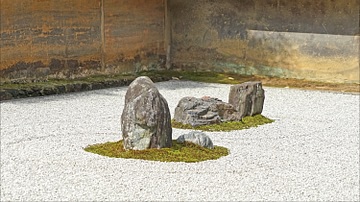
Ryoanji
Ryoanji (Ryōan-ji) is a Zen Buddhist temple in Kyoto, Japan which is today most famous for its Zen rock garden with its enigmatic arrangement of stones. Founded in the 15th century CE, the temple is one of the most visited tourist spots...
Image
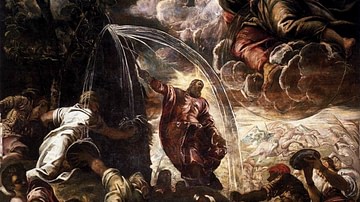
Moses Drawing Water from the Rock by Tintoretto
The oil painting Moses Drawing Water from the Rock by the Italian Renaissance artist Tintoretto (c. 1518-1594 CE). c. 1577 CE. (Scuola Grande di San Rocco, Venice)

Image
Main Carving, Rock-Cut Tombs of Qizqapan
This is the main scene, carved between the engaged Iranian ionic-style columns and above the entrance into the main chamber of the rock-cut tombs of Ashkawt-i Qizqapan (Kurdish: The Cave of the Ravisher or...

Image
Approach Path, Rock-Cut Tombs of Qizqapan
The road to Ashkawt-i Qizqapan (Kurdish: The Cave of the Ravisher or the Cave of the Raped/Abducted Girl), which lies in Chemi Rezan Valley, Sulaymaniyah Governorate, Iraqi Kurdistan. It is not a cave; it is...

Image
Cliff Face, Rock-Cut Tombs of Qizqapan
The rock-cut tombs of Ashkawt-i Qizqapan (Kurdish: The Cave of the Ravisher or the Cave of the Raped/Abducted Girl). The “cave” is carved into the cliff of the mountain and is approximately 8 meters above the...
