
Search
Did you mean: Ramesses II?
Remove Ads
Advertisement
Search Results

Definition
Perdiccas
Perdiccas (d. 321 BCE) was one of Alexander the Great's commanders, and after his death, custodian of the treasury, regent over Philip III and Alexander IV, and commander of the royal army. When Alexander the Great crossed the Hellespont...

Definition
Civil Constitution of the Clergy
The Civil Constitution of the Clergy was a law passed in July 1790 during the French Revolution (1789-1799), which caused the immediate subordination of the Catholic Church in France to the French government. An attempt...

Article
Battle of Crécy
The Battle of Crécy on 26 August 1346 CE saw an English army defeat a much larger French force in the first great battle of the Hundred Years' War (1337-1453 CE). Edward III of England (r. 1327-1377 CE) and his son Edward the...

Article
Battle of Poitiers, 1356 CE
The Battle of Poitiers on 19 September 1356 CE was the second great battle of the Hundred Years' War (1337-1453 CE) after Crécy (1346 CE) and, once again, it was the English who won. Edward the Black Prince (1330-1376...
Article
Legions of Noricum, Raetia & Dacia
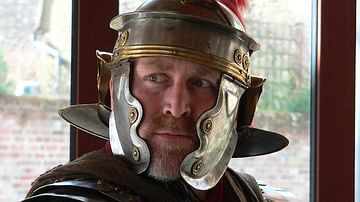
The provinces Noricum, Raetia, and Dacia served as a buffer protecting Roman Empire against any possible outside threat. However, the region posed several internal problems for Rome: Pannonia and its ally Dalmatia...

Article
Mortimer and Isabella - The Lovers Who Brought Down a King
On 22 September 1326, a strong wind carried 95 ships from the shores of Flanders into the foamy maw of the North Sea. The weather was fair for the first hours of their voyage, but gradually, blue...

Image
Glazed Polychrome Tile from Tell el-Yahudieh
This decorative tile of glazed faience originally ornamented the walls of a palace of King Ramesses III at Tell e-Yahudieh in the Egyptian Delta. This (and other tiles) would once have been included in symbolic...

Definition
The Barracks Emperors - Instability of Populist Rule
The "barracks emperors" is a term coined by later historians referring to the Roman emperors who were chosen and supported by the army during the period known as the Crisis of the Third Century (also...
Collection
The Plantagenets
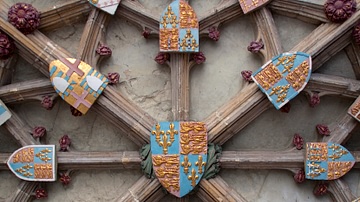
The Plantagenets, sometimes referred to as the Angevin-Plantagenets, were the ruling dynasty of England from 1154 to 1485 CE. The name Angevin derives from the family's ancestral lands in Anjou, France and the term Plantagenet...

Article
History of Assyria
The foundation of the Assyrian dynasty can be traced to Zulilu, who is said to have lived after Bel-kap-kapu (c. 1900 BCE), the ancestor of Shalmaneser I. The city-state of Ashur rose to prominence in northern Mesopotamia, founding...
