
Search
Did you mean: Ramesses II?
Remove Ads
Advertisement
Search Results

Article
Battle of Jena-Auerstedt
The twin battles of Jena and Auerstedt, both fought on 14 October 1806, marked a major turning point in the Napoleonic Wars (1803-1815). It saw the French Grande Armée, led by Emperor Napoleon I (r. 1804-1814; 1815) soundly...

Article
Polybius' Capture of Achaeus and Fall of Sardis
Polybius' Capture of Achaeus and Fall of Sardis is the account of the end of the Siege of Sardis (215-213 BCE) by Antiochus III (aka Antiochus the Great, r. 223-187 BCE) of the Seleucid Empire after the...

Article
Great Female Rulers of Ancient Egypt
Women in ancient Egypt had more rights than in any other ancient culture and were valued with greater respect. This is evident not only in the physical evidence and inscriptions but in their religion. Some of the...

Article
Ancient Egyptian Taxes & the Cattle Count
The gods of ancient Egypt freely gave their bounty to the people who worked the land, but this did not exempt those farmers from paying taxes on that bounty to the government. Egypt was a cashless society until...
Article
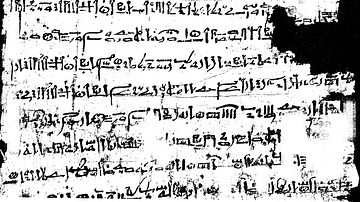
The Report of Wenamun & the Perils of Living in the Past
The Report of Wenamun (also known as The Tale of Wenamun or The Report of Wenamon) is an Egyptian literary work dated to c. 1090-1075 BCE toward the end of the New Kingdom (c.1570 - c. 1069 BCE...

Video
SHAKESPEARE EXPLAINED Richard III Act 1 Scene 2
Richard III Act 1 Scene 2 explained in depth. Part of the Shakespeare Explained series, this video will help you to understand Shakespeare and what is being said in the play. This Shakespeare Explained...

Definition
King John of England - England's Most Unpopular King?
King John of England (aka John Lackland) ruled from 1199 to 1216 CE and he has gone down in history as one of the very worst of English kings, both for his character and his failures. He lost the Angevin-Plantagenet...

Definition
Treaties of Tilsit
The Treaties of Tilsit were two peace treaties signed in July 1807 by Emperor Napoleon I of France (r. 1804-1814; 1815) and the monarchs of Russia and Prussia in the aftermath of the Battle of Friedland. The treaties ended the...

Definition
Leo VI
Leo VI was emperor of the Byzantine empire from 886-912 CE. He was the second emperor of the Macedonian dynasty and is sometimes known as “Leo the Wise” in reference to his prolific literary output which ranged from orations to law codes...

Definition
Norman Conquest of England
The Norman Conquest of England (1066-71) was led by William the Conqueror who defeated King Harold II at the Battle of Hastings in 1066. The Anglo-Saxon elite lost power as William redistributed land to his fellow Normans...
