
Search
Did you mean: Praetor?
Remove Ads
Advertisement
Search Results

Article
Tibetan Sand Mandalas
Tibetan sand mandalas are works of art created to encourage healing, peace, and purification generally as well as spiritual or psychological focus specifically for those creating and viewing it. A mandala (Sanskrit for "circle"...

Article
Elephants in Hellenistic History & Art
Elephants were thought of as fierce and frightful monsters in antiquity, very real though rarely seen until the Hellenistic period. They were deployed on the battlefield to strike terror into the enemy, however...

Article
Why Kokopelli is Not Kokopelli: Paiyatamu & The Four Flutes
The iconic image of Kokopelli, the flute-playing kachina spirit of the Pueblo peoples, specifically the Hopi, is easily the most recognizable figure from Native American culture in the Southwest...

Article
Reverend James Drummond MacGregor's Letter to a Clergyman - Urging Him to Set Free a Black Girl He Held in Slavery
James Drummond MacGregor (1759-1830) was a Presbyterian minister in Pictou, Nova Scotia, who became the first published abolitionist in Canada through...

Article
The Monastic Movement: Origins & Purposes
In 313 CE, Constantine the Great (272 – 337 CE) ended the sporadic-yet-terrifying Christian persecutions under the Roman Empire with his “Edict of Milan,” and brought the Christian church under imperial protection...

Article
15 Complete Hyangga Songs from Ancient Korea
Hyangga was a form poetical 'country song,' distinct from contemporary Chinese songs, which were written in the Silla and Goryeo kingdoms of ancient Korea between the 7th and 10th century CE. The indigenous...

Article
History of Halloween
Halloween is among the oldest traditions in the world as it touches on an essential element of the human condition: the relationship between the living and the dead. The observance evolved from ancient rituals marking the...
Article
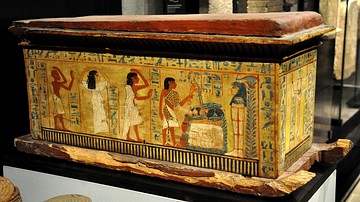
The Egyptian Afterlife & The Feather of Truth
Is it possible to have a heart that is lighter than a feather? To the ancient Egyptians it was not only possible but highly desirable. The after-life of the ancient Egyptians was known as the Field of Reeds...

Article
Curses & Fines on Epitaphs
The concept of a curse laid on a tomb or gravesite is best known from ancient Egypt but the practice was quite common in other civilizations of antiquity. The tomb or grave was the eternal home of the physical remains...

Article
Renaissance Altarpieces
During the Renaissance (1400-1600) just about any artist of worth found themselves commissioned at some point in their careers to produce an altarpiece. Some of the greatest names in European art were so called upon, from...
