
Search

 This answer was generated by
 Search Results
Image
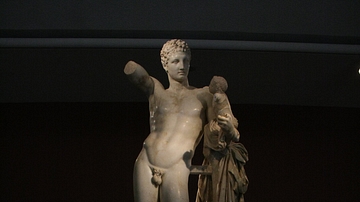
Hermes of Praxiteles
This statue was uncovered during excavations in 1877 at the Temple of Hera at Olympia. The statue captures the myth where Hermes takes the baby Dionysos to the Nymphs, where on his way he rests upon a tree trunk, having thrown his cloak over...

Article
Disarming Aphrodite: Rediscovering the Venus de Milo
The so-called Vénus de Milo is perhaps one of the most iconic works of Western art of any period. The statue of the goddess was found on the Aegean island of Milos, to which she owes her name, on the eve of the Greek War of Independence (1821-1830...
Definition
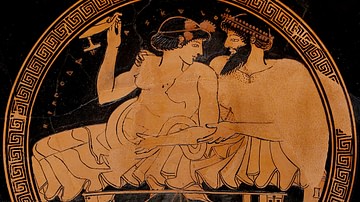
Hetaira
A hetaira (pl. hetairai) was an educated female prostitute in ancient Greece and a common participant in symposia or drinking parties in private homes. Sometimes referred to in English as a courtesan, the Greek term hetaira was a euphemism...

Article
Pausanius' Guide To Ancient Athens
Pausanius (l. 110-180 CE) was a geographer and historian who traveled extensively, taking notes on points of interest, then wrote on them in guide books which could be used by tourists visiting the sites described. His works have long been...
Image
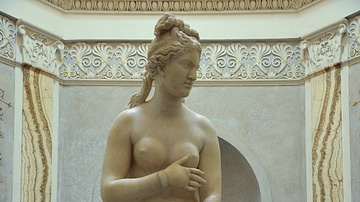
Capitoline Venus
The Capitoline Venus is a type of statue of Venus, specifically one of several Venus Pudica (modest Venus) types, of which several examples exist. The type ultimately derives from the Aphrodite of Cnidus. The so-called “Capitoline Venus”...

Definition
Hermes - The Messenger of the Olympian Gods
Hermes was the ancient Greek god of trade, wealth, luck, fertility, animal husbandry, sleep, language, thieves, and travel. One of the cleverest and most mischievous of the 12 Olympian gods, Hermes was their herald and messenger. In that...

Definition
Statue of Zeus at Olympia
The monumental statue of Zeus at Olympia in Greece was one of the Seven Wonders of the Ancient World. Created in the 430s BCE under the supervision of the master Greek sculptor Phidias, the huge ivory and gold statue was bigger even than...

Definition
Ancient Greek Sculpture
The sculpture of ancient Greece from 800 to 300 BCE took inspiration from Egyptian and Near Eastern monumental art, and evolved into a uniquely Greek vision of the art form. Greek artists captured the human form in a way never before seen...

Definition
Dionysos
Dionysos (Roman name: Bacchus, also known as Dionysus) was the ancient Greek god of wine, merriment, and theatre. Being the bad boy of Mt. Olympus, Dionysus was perhaps the most colourful of the Olympian Gods. Son of Zeus In Greek mythology...

Definition
Mausoleum at Halicarnassus
The Mausoleum at Halicarnassus (Bodrum, Turkey), was a massive tomb built for Mausolus, the ruler of Caria, c. 350 BCE. The marble structure was so immense and decorated with such an array of striking sculptures that it made it onto the list...
