
Search
Remove Ads
Advertisement
Search Results

Definition
Mausoleum at Halicarnassus
The Mausoleum at Halicarnassus (Bodrum, Turkey), was a massive tomb built for Mausolus, the ruler of Caria, c. 350 BCE. The marble structure was so immense and decorated with such an array of striking sculptures that it made it onto the list...

Definition
Tyche
In Greek mythology, Tyche is the goddess and personification of good luck, chance, and fortune. Tyche's popularity grew after the Classical period when many cities and officials across the Greek world and the Mediterranean adopted her as...

Definition
Paros
Paros is an island in the Cyclades group in the central Aegean. It is the third largest island of the Cyclades and its position on important sea routes between mainland Greece and the coast of Asia Minor made it an important centre from the...
Article
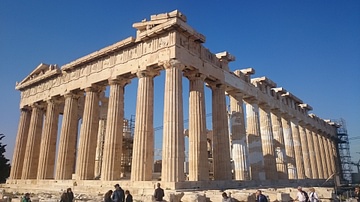
Greek World Heritage Sites
Greece, the 'cradle of western civilization', is home to a large number of spectacular sites from the ancient world, several of which have been placed on the UNESCO World Heritage List. These sites of great historical importance, interest...

Article
Museums in the Ancient Mediterranean
Museums have been around much longer than one might think, but in the ancient world, they were principally institutions of research and learning rather than places to display artworks and artefacts, even if they were often located in grand...
Image
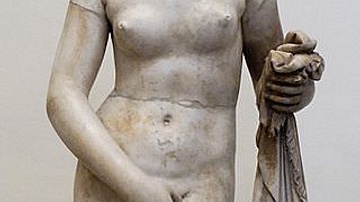
Aphrodite of Knidos
Roman copy of Aphrodite of Knidos by Praxiteles (4th cent BCE); restored by Ippolito Buzzi (Italian, 1562–1634 CE)
Image
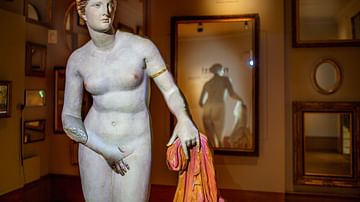
Aphrodite of Knidos with Colours
The Aphrodite of Knidos in a reconstruction from plaster casts and “completed” by projected colours suggesting her former polychromy. This famous statue, created by Praxiteles around 340 BCE, was originally set up in the Aphrodite sanctuary...
Image
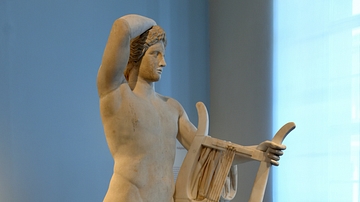
Statue of Apollo Lykeios
The head and body of two different Roman copies were combined in the 18th century CE. The god appears in the so-called "Lykeios type", with the right forearm resting across his head. The model was either an original, created around 340 BCE...
Image
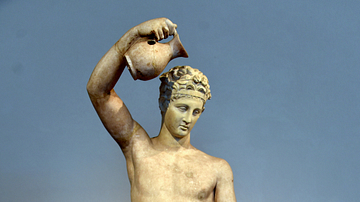
Statue of a Satyr from Sabina
This marble statue came from the Villa at Monte Calvo in Sabina, Italy. In the villa, the boyish satyr was part of a fountain, for the jug is pierced for receiving a water pipe. The Berlin statue belongs to a series of copies, which go back...

Image
Hermes Farnese
Statue of Hermes (Mercury) with winged sandals, holding his herald's staff. Formerly in the Farnese Collection in Rome. Roman, 2nd century CE, after a Greek original of the 4th century BCE the school of Praxiteles. (British Museum, London)
