
Search
Did you mean: Horus?
Remove Ads
Advertisement
Search Results

Definition
Lysimachus
Lysimachus (c. 361-281 BCE) was one of Alexander the Great's trusted bodyguards and a member of his Companion Cavalry. Although he obtained Macedonian citizenship, his father was a Thessalian named Agathocles. After the death of Alexander...

Definition
Argead Dynasty
The Argead dynasty, the ancient Macedonian house of Dorian Greek origin, lasted from the 7th century to 310 BCE. The mythological founder of the dynasty was King Caranus but it was under Philip II of Macedon (382-226 BCE) that the Macedonian...

Definition
Pezhetairoi
The pezhetairoi (foot companions) were part of the imposing army that accompanied the Macedonian commander Alexander the Great (r. 336-323 BCE) when he crossed the Hellespont to face the Persian king Darius III in 334 BCE. Armed with long...

Article
The Army of Alexander the Great
No military commander in history has ever won a battle by himself. To be successful he needs the support of a well-trained army who will follow him regardless of the cost whether it be a stunning victory or hopeless defeat. One need only...

Article
Death of Alexander the Great
In June of 323 BCE, Alexander the Great (r. 336-323 BCE) died in Babylon. His sudden death before his 33rd birthday has long been a point of speculation: was it disease, old wounds, or murder? Regardless of the cause, history ranks him as...

Article
Chariots in Ancient Indian Warfare
The chariot was the elite arm of ancient Indian armies in the Vedic (1500 BCE – 1000 BCE) and Epic periods (described by the Ramayana and the Mahabharata, 1000-600 BCE) because of the advantages it conferred and the selection of plain ground...
Article
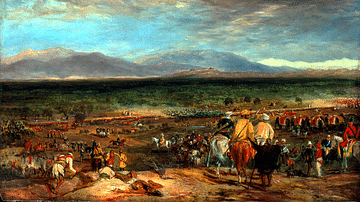
Battle of Chillianwala
The Battle of Chillianwala on 13 January 1849 was a bloody and indecisive clash between the British East India Company (EIC) and the Sikh Empire during the Second Anglo-Sikh War (1848-9). The EIC commander, General Gough, employed the dated...

Article
Diodorus Siculus' Account of the Life of Semiramis
Semiramis is the semi-divine Warrior-Queen of Assyria, whose reign is most clearly documented by the Greek historian Diodorus Siculus (l. 90-30 BCE) in his great work Bibliotheca Historica ("Historical Library") written over thirty years...

Image
Map of the Cities Named Alexandria by Alexander the Great - How One Name Marked the Map of Conquest
The urban foundations of Alexander the Great (Alexander III of Macedon, reign 336–323 BCE) formed a deliberate component of his imperial strategy during his campaigns across the Near East, Central Asia, and the northwestern Indian subcontinent...

Image
Battle of Hydaspes
The positions before the Battle of Hydaspes, 326 BCE. In blue are the forces of Alexander the Great whilst in red are those of King Porus.
