
Search
Did you mean: Horus?
Remove Ads
Advertisement
Search Results

Article
Battle of Hydaspes
For almost a decade, Alexander the Great and his army swept across Western Asia and into Egypt, defeating King Darius III and the Persians at the battles of River Granicus, Issus and Gaugamela. Next, despite the objections of the loyal army...
Image
Alexander & Porus
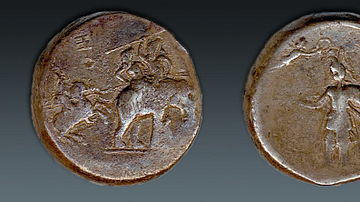
A rare silver medallion decadrachm depicting Alexander the Great on horseback attacking King Porus on elephant; the reverse shows the Macedonian king holding a thunderbolt while being wreathed by Nike Babylon (?), c. 325/4-322/1 BCE The...

Definition
Alexander the Great
Alexander III of Macedon, better known as Alexander the Great (l. 21 July 356 BCE – 10 or 11 June 323 BCE, r. 336-323 BCE), was the son of King Philip II of Macedon (r. 359-336 BCE) who became king upon his father's death in 336 BCE and then...

Article
The Hyphasis Mutiny
The so-called Hyphasis Mutiny was a conflict between Alexander the Great (356-323 BCE) and his army following their victory at the river Hydaspes in 326 BCE. Alexander voiced plans for further conquests in the Indian subcontinent, however...

Article
Elephants in Greek & Roman Warfare
In the search for ever more impressive and lethal weapons to shock the enemy and bring total victory the armies of ancient Greece, Carthage, and even sometimes Rome turned to the elephant. Huge, exotic, and frightening the life out of an...
Definition
Arthashastra
The Arthashastra is an Indian treatise on politics, economics, military strategy, the function of the state, and social organization attributed to the philosopher and Prime Minister Kautilya (also known as Chanakya, Vishnugupta, l. c. 350-275...

Definition
Seleucus I Nicator
Seleucus I Nicator (l. c. 358-281 BCE, r. 305-281 BCE) was one of the generals of Alexander the Great (l. 356-323 BCE) who made up the group of Diadochi ("successors") who divided the vast Macedonian Empire between them after the death of...

Article
Cultural Links between India & the Greco-Roman World
Cyrus the Great (558-530 BCE) built the first universal empire, stretching from Greece to the Indus River. This was the famous Achaemenid Empire of Persia. An inscription at Naqsh-i-Rustam, the tomb of his able successor Darius I (521-486...

Article
Elephants in Hellenistic History & Art
Elephants were thought of as fierce and frightful monsters in antiquity, very real though rarely seen until the Hellenistic period. They were deployed on the battlefield to strike terror into the enemy, however, since fear was considered...

Definition
Hephaestion
Hephaestion was a member of Alexander the Great's personal bodyguard and the Macedonian king's closest and lifelong friend and advisor. So much so, Hephaestion's death would bring the young king to tears. From 334 to 323 BCE Alexander the...
