
Search
Remove Ads
Advertisement
Search Results

Curriculum Collection
AP World History Unit 4 - Transoceanic Interconnections (c. 1450–1750)
Between 1450 and 1750, new maritime technology allowed European states to reach the Americas, Africa, and Asia by sea for the first time, linking the Eastern and Western Hemispheres in...

Image
The Chicken's Wedding Panel
The Chicken’s Wedding panel (1660-1667 CE) is an azulejo (glazed ceramic tile) from the 17th century CE. A chicken is conveyed in a carriage that is escorted by a cortege of monkeys playing musical instruments. Singerie...

Image
Almourol Castle, South Entrance & Batter
South side of Almourol Castle, photograph by Filipa Oliveira, Almourol, Portugal, May 2026. After getting out of the boat and walking up to the southern side of the castle with batter, one can spot the Latin...

Image
Latin Inscription at the Main Entrance of Almourol Castle
Latin inscription at the main entrance of Almourol Castle, photograph by Filipa Oliveira, Almourol, Portugal, May 2026. The inscription reads: “ERA MCCIX. M. GUALDINUS NOBILI QUIDEM GENERE BRACHARENSIS...

Image
Retábulo de Nossa Senhora da Vida
Retábulo de Nossa Senhora da Vida (1580 CE) or Our Lady of Life is Portugal’s oldest azulejo (glazed ceramic tile) and is an important piece of 16th century CE Portuguese tile production. It is on display at the...

Image
Almourol Castle, North Side
North side of Almourol Castle, photograph by Filipa Oliveira, Almourol, Portugal, May 2026. Almourol Castle sits on an islet, with the north, east, and west sides flanked by the Tagus River, while the south side connects...

Image
Almourol Castle, 3D Model
A 3D model highlighting the main features of Almourol Castle, photograph by Filipa Oliveira, Almourol, Portugal, August 2026.
This model of the fortress focuses exclusively on the castle, rather than the islet itself.

Image
Almourol Castle, East
From where the sun rises to warm the ancient stones of Almourol Castle, lighting the walls and greeting the Tagus River, photograph by Filipa Oliveira, Almourol, Portugal, May 2026.

Image
Invitation Figure
The Baroque (c. 1600-1750 CE) and Rococo (c. 1700-1800) movements led to a style of azulejos (glazed ceramic tile) that is unique to Portugal – figuras de convite or invitation figures. These were ornate life-size figures, usually...
Image
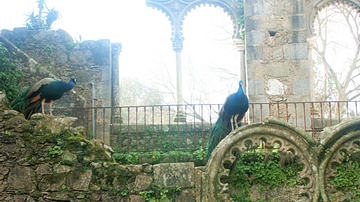
Peacocks in Jardim Publico de Evora
Peacocks in Jardim Publico de Evora (Evora Public Garden), Evora, Portugal. Photo taken in 2008 CE.
