
Search
Remove Ads
Advertisement
Search Results

Image
Arab Room Tiles, Sintra Palace
Islamic ceramic tiles in the Arab Room in the Sintra palace (Palácio Nacional de Sintra), Portugal. King Manuel I of Portugal (r.1495-1521 CE) imported azulejos (glazed ceramic tiles) from the Alhambra palace in Granada...

Image
Retábulo de Nossa Senhora da Vida
Retábulo de Nossa Senhora da Vida (1580 CE) or Our Lady of Life is Portugal’s oldest azulejo (glazed ceramic tile) and is an important piece of 16th century CE Portuguese tile production. It is on display at the...
Image
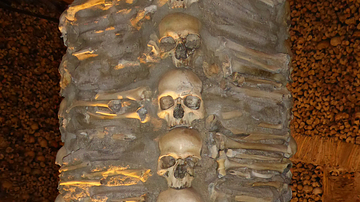
Capela dos Ossos Bone Pillar
Pillar at the Capela dos Ossos (Chapel of Bones), Evora, Portugal showing human skulls and bones. The Chapel of Bones was constructed by Franciscan monks in the late 16th century CE. Photo taken 2016 CE.
Image
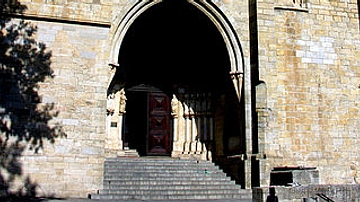
Evora Cathedral
The great (main) door of Evora Cathedral, Evora, Portugal. Photo taken 2006 CE.
Image
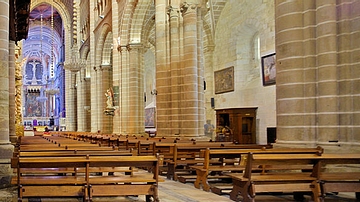
Interior of Evora Cathedral
Interior of Evora Cathedral, Evora Portugal. Photo taken 2011 CE.

Image
The Chicken's Wedding Panel
The Chicken’s Wedding panel (1660-1667 CE) is an azulejo (glazed ceramic tile) from the 17th century CE. A chicken is conveyed in a carriage that is escorted by a cortege of monkeys playing musical instruments. Singerie...
Image
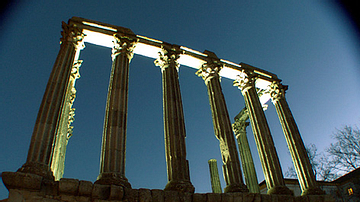
Temple of Diana
Temple of Diana in Largo Conde Vila Flor Square Evora, Portugal - night photo. The temple was constructed in the 1st century CE. Photo take 2005 CE.

Image
Invitation Figure
The Baroque (c. 1600-1750 CE) and Rococo (c. 1700-1800) movements led to a style of azulejos (glazed ceramic tile) that is unique to Portugal – figuras de convite or invitation figures. These were ornate life-size figures, usually...
Image
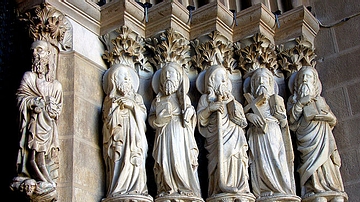
Statues of the Apostles
Sculptures of the twelve apostles at Evora Cathedral, Portugal - attributed to Pero and Telo de Garcia (Spanish sculptors of the 14th century CE). Photo take 2006 CE.

Image
Scene on the Tagus Near Thomar
Scene on the Tagus Near Thomar, illustration from Travels Through Portugal and Spain, During the Peninsular War by William Graham, 1820. This illustration captures Graham's description of the "green island," Almourol...
