
Search
Remove Ads
Advertisement
Search Results

Article
Unam Sanctam: Spiritual Authority & the Medieval Church
The Unam Sanctam (1302) was a papal bull issued by Pope Boniface VIII (served 1294-1303) requiring the complete submission of all people, including kings, to the authority and dictates of the pope...
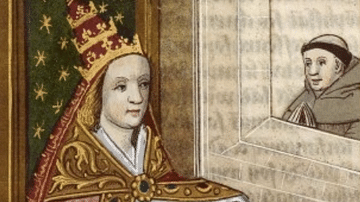
Image
Pope Joan
A 15-16th century manuscript illustration of Pope Joan, a legendary female pope of the Middle Ages said to have reigned from 855 to 858. Her existence is disputed. (Bibliothèque nationale de France).

Definition
Protestant Reformation
The Protestant Reformation (1517-1648) refers to the widespread religious, cultural, and social upheaval of 16th-century Europe that broke the hold of the medieval Church, allowing for the development of personal interpretations...

Definition
Jan Hus
Jan Hus (also John Huss, l. c. 1369-1415) was a Czech philosopher, priest, and theologian who, inspired by the work of John Wycliffe (l. 1330-1384) challenged the policies and practices of the medieval Church and so launched the Bohemian...

Definition
John Wycliffe
John Wycliffe (l. 1330-1384, also John Wyclif) was an English theologian, priest, and scholar, recognized as a forerunner to the Protestant Reformation in Europe. Wycliffe condemned the practices of the medieval Church, citing many...

Definition
Chlothar I
Chlothar I (l. c. 498-561) was a Merovingian king of the Franks, the second to rule over a unified Frankish kingdom after his father, Clovis I (l. c. 466-511). When Clovis died in 511, his kingdom was divided up between his four sons...

Image
Pope Urban II
A statue of Pope Urban II (r. 1088-1099 CE) who called for the First Crusade (1095-1202 CE). Clermont-Ferrand, France.

Image
Pope Innocent III & the Albigensian Crusade
A medieval manuscript illustration showing Pope Innocent III (r. 1198-1216 CE) and the crusaders of the Albigensian Crusade in southern France (1209-1229 CE). (Chronicles of Saint-Denis, British Library...
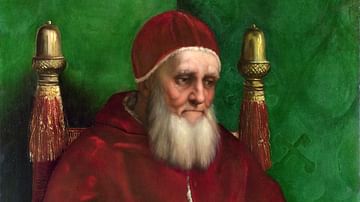
Image
Pope Julius II by Raphael
A portrait of Pope Julius II (r. 1503-1513 CE) by the Italian Renaissance artist Raphael, c. 1512 CE. (National Gallery London)
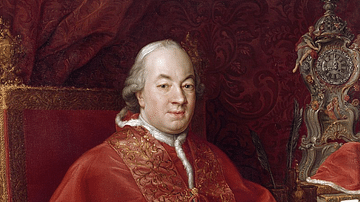
Image
Pope Pius VI
A 1775 portrait by Pompeo Batoni of Pope Pius VI (r. 1775-99). (National Gallery of Ireland)
