
Search
Remove Ads
Advertisement
Search Results

Definition
Legio I Adiutrix
Legio I Adiutrix was a legion of the Roman army formed from veteran sailors after the death of Roman emperor Nero (r. 54-68 CE). During its long career, the legion accompanied Trajan (r. 98-117 CE) on his Dacian and Parthian campaigns...

Definition
Scythian Warfare
Scythian warfare used state-of-the-art recurve bows and hit-and-run tactics against set infantry formations. Working from nimble horses, Scythian warriors could unleash a cloud of lethal arrows. Known, too, for their innovative...
Definition
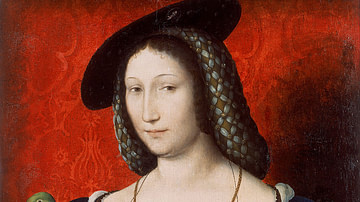
Marguerite de Navarre
Marguerite de Navarre (l. 1492-1549) was a writer, philosopher, diplomat, and Queen of Navarre, sister of King Francois I (Francis I of France, r. 1515-1547), mother of Jeanne d’Albret (l. 1528-1572) and grandmother of Henry...

Definition
Octavia Minor - The Sister of Augustus Who Helped Birth the Roman Empire
Octavia Minor (circa 69 BCE to 11 BCE) was a Roman noblewoman who rose to prominence during the early years of the Roman Empire. The sister of Emperor Augustus (reign 27 BCE to 14 CE...

Definition
Joseph II, Holy Roman Emperor - The Great Enlightened Despot
Joseph II, Holy Roman Emperor (1741-1790), was the son and successor of Maria Theresa (1717-1780) and Francis Stephen, aka Francis I (1708-1765), of the imperial house of the Habsburgs. He governed...
Definition
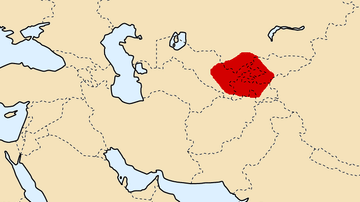
Sogdiana
Sogdiana (or Sogdia) is a region in Central Asia between the mighty rivers Iaxartes in the north and Oxus in the south. Its eastern and western limits are more difficult to determine, especially since the toponym Sogdiana covered different...

Definition
Hatshepsut
Hatshepsut (r. 1479-1458 BCE) was the first female ruler of ancient Egypt to reign as a male with the full authority of pharaoh. Her name means "Foremost of Noble Women" or "She is First Among Noble Women". She began her reign as...

Definition
Tutankhamun
Tutankhamun (also known as Tutankhamen and `King Tut', r. c.1336-c.1327 BCE) is the most famous and instantly recognizable Pharaoh in the modern world. His golden sarcophagus is now a symbol almost synonymous with Egypt. His name...

Definition
New Kingdom of Egypt - The Age of Empire
The New Kingdom (circa 1570 to circa 1069 BCE) is the era in Egyptian history following the disunity of the Second Intermediate Period (circa 1782-1570 BCE) and preceding the dissolution of the central government...

Definition
Leo V the Armenian
Leo the V the Armenian was emperor of the Byzantine Empire from 813 to 820 CE. He was of Armenian descent and the last ruler of the Isaurian dynasty which had been founded by Leo III (r. 717-741 CE). The emperor's reign, after...
