
Search
Did you mean: Sulla?
Remove Ads
Advertisement
Search Results

Definition
Battle of Pydna
The Battle of Pydna in June 168 BCE was a decisive Roman victory that ended the Third Macedonian War and established Rome as the dominant power in the Mediterranean. The Roman Republic was expanding, enlarging its sphere of influence...

Definition
Arsinoe II Philadelphus
Arsinoe II (l. c. 318/311 - c. 270/268 BCE), daughter of Ptolemy I became one of the most enduring figures of the Lagid or Ptolemaic Dynasty and left an undeniable mark in the historical evidence. She was married three times...
Definition
Bacchae
The Bacchae is a Greek tragedy written by the playwright Euripides (c. 484-406 BCE) in 407 BCE, which portrays Pentheus as an impious king, for the ruler of Thebes has denied the worship of Dionysus within his city walls. For Pentheus...

Definition
Thessalonike of Macedon
Thessalonike of Macedon (c. 345-295 BCE) was the daughter of Philip II of Macedon (r. 359-336 BCE) and one of his several consorts, Nikesipolis of Pherae (also spelt Nicesipolis). Born to the Argead family of Macedonian...

Article
Early Muslim Conquests (622-656 CE)
Islam arose as a religious and socio-political force in Arabia in the 7th century CE (610 CE onwards). The Islamic Prophet Muhammad (l. 570-632 CE), despite facing resistance and persecution, amassed a huge following...

Article
Roman Mosaics
Roman mosaics were a common feature of private homes and public buildings across the empire from Africa to Antioch. Not only are mosaics beautiful works of art in themselves but they are also an invaluable record of such everyday...

Article
Libraries in the Ancient World
Libraries were a feature of larger cities across the ancient world with famous examples being those at Alexandria, Athens, Constantinople, Ephesus, and Nineveh. Rarely ever lending libraries, they were typically designed...
Article
Battle of Yarmouk
The Battle of Yarmouk River (or Yarmuk River; also written as the Battle of Jabiya-Yarmuk) was fought over the course of six days, from 15 to 20 August 636 CE, between the Muslim army of the Rashidun Caliphate (632-661 CE), under...

Article
Warrior Women of the World of Ancient Macedon
The 8th November is celebrated as Archangels Day in Greece, but on that November day in 1977 CE something remarkable happened: an excavation team led by Professor Manolis Andronikos were roped down into...
Image
Via Egnatia, 146 BCE to c. 1200 CE
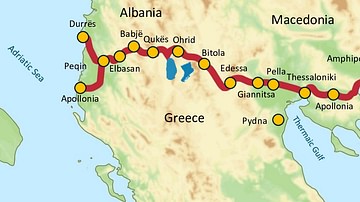
Via Egnatia was a major Roman road in the Balkans, stretching 1,120 kilometers (696 miles) from the Adriatic Sea in the west to the Black Sea and the Sea of Marmara in the east. The western terminus is slightly...
