
Search
Did you mean: Sulla?
Remove Ads
Advertisement
Search Results

Image
Hephaestion Votive
Votive statue to the "Hero Hephaestion" dated to the last quarter of the 4th century CE, found in Pella.
Picture taken from Thessaloniki Museum

Image
Gold Ivy Wreath from Nea Apollonia, Thessaloniki
Gold ivy wreath from Nea Apollonia, Thessaloniki, 350-325 BCE. Archaeological Museum of Thessaloniki. Ceremonial wreaths were among the most prestigious adornments in the ancient Greek world. Probably...

Image
Coin of Demetrius I of Macedon
Tetradrachm portraying Demetrius I of Macedon (ruled 294 – 288 BCE). On the reverse, Poseidon stands left, foot on rock, holding trident. The Greek inscription reads ΒΑΣΙΛΕΩΣ ΔΗΜΗΤΡΙΟΥ "King Demetrius". (Archaeological...
Image
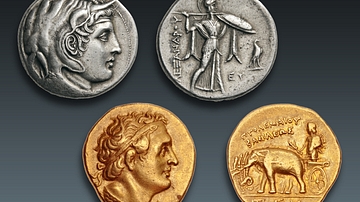
Elephant Symbolism on the Coins of Ptolemy I
Two coins issued by Ptolemy I: 1) A portrait of the deified Alexander the Great wearing an elephant scalp on his head, with a ram’s horn over his temple, and an aegis (sacred fleece) over his shoulder...
Image
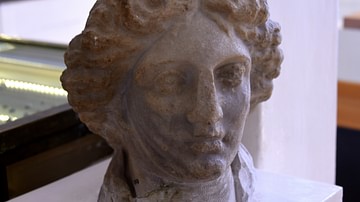
Head of Goddess Artemis
Marble head of Artemis, the Greek goddess of the hunt, forests and hills, and archery, from Pella, the Jordan Valley, modern-day Jordan Hashemite Kingdom, 1st century CE.
Jordan Archaeological Museum, Amman.

Video
Early Muslim Expansion - Conquest of Syria and Iraq 602-636 CE
In the new Kings and Generals full animated historical documentary, we will describe the rise of the Rashidun Caliphate, its first wars against the Eastern Roman and Sassanid Empires. This...
