
Search
Remove Ads
Advertisement
Search Results
Image
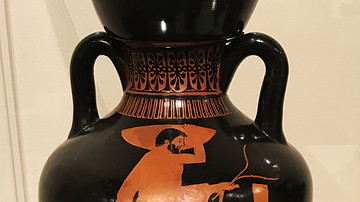
Amphora of a Panathenaic Shape
This red-figure terracotta vase was made by the Eucharides Painter (c. 500-475 BCE) who worked in Athens, Greece during the Archaic Period (1000-480 BCE). This piece dates from 480 BCE. (Iris & B. Gerald Cantor Center...

Definition
Acropolis
An acropolis is any citadel or complex built on a high hill. The name derives from the Greek akro, "high" or "extreme/extremity" or "edge", and polis, "city", translated as "high city", "city on the edge" or "city in the air", the...

Video
Origin and History of the Ancient Olympic Games
The Olympic Games as we know them today began in April of 1896 in Athens, where the city welcomed 13 nations to compete, but this video is going way back to the year 776 BCE and it's going to explore the...

Definition
Cynisca of Sparta
Cynisca of Sparta (b. c. 440 BCE) was a Spartan royal princess who became the first female Olympic champion. Defying the traditional role of women in ancient Greece, she competed in the Olympic Games alongside the men and won...

Definition
Olympia
Ancient Olympia was an ancient Greek sanctuary site dedicated to the worship of Zeus located in the western Peloponnese. The Pan-Hellenic Olympic Games were held at the site in honour of Zeus every four years from 776 BCE to 393 CE...

Article
Pericles & the Restoration of the Athenian Agora
The agora of Athens developed from the 6th century BCE until it was destroyed in the Persian invasion of 480 BCE. Afterwards, the statesman Pericles (l. 495-429 BCE) used funds from the Delian League...
Image
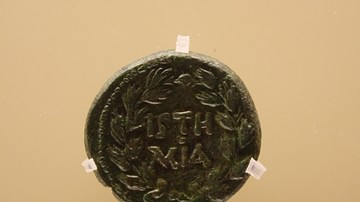
Coin Commemorating the Isthmian Games
A Greek coin commemorating the Isthmian Games. Corinth, 117-138 CE. (Numismatics Museum, Athens)

Definition
Nemea
Nemea was a religious sanctuary in the northern Peloponnese of Greece where pan-Hellenic athletic games were held every two years from 573 BCE until 271 BCE, after which, the Games were definitively moved to Argos. Early Settlement...

Article
Female Gladiators In Ancient Rome
Female gladiators in ancient Rome – referred to by modern-day scholars as gladiatrix – may have been uncommon but they did exist. Evidence suggests that a number of women participated in the public games of Rome...

Definition
Greek Archaic Period
The Greek Archaic Period (c. 800-479 BCE) started from what can only be termed uncertainty, and ended with the Persians being ejected from Greece for good after the battles of Plataea and Mykale in 479 BCE. The Archaic Period...
