
Search
Remove Ads
Advertisement
Search Results

Definition
Odyssey - Homer's Epic Poem of Redemption
Homer's Odyssey is an epic poem written in the 8th century BCE which describes the long voyage home of the Greek hero Odysseus. The mythical king sails back to Ithaca with his men after the Trojan War but is...

Definition
Antinous
Antinous (l. c. 110-130 CE) was a youth of Bithynia who became the beloved of the Roman emperor Hadrian (l. 76-138 CE, r. 117-138 CE) from around the age of 13 until his death at nearly 20. His year of birth is unknown as are any details...
Definition
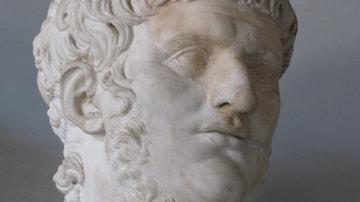
Nero - The Artist Emperor
Nero (37-68 CE) was the fifth Roman emperor, who reigned from 54 to 68 CE. The last emperor of the Julio-Claudian Dynasty, he came to power at the age of 16 with the help of his mother, Agrippina the Younger. Initially...

Definition
Ancient Greek Religion
In the ancient Greek world, religion was personal, direct, and present in all areas of life. With formal rituals which included animal sacrifices and libations, myths to explain the origins of mankind and give the gods a...

Definition
Peter the Great
Peter I of Russia (Peter the Great) was the Tsar of Russia from 1682-1721 and Emperor of Russia from 1721-1725. During his long reign, Peter had absolute power and brought real change to Russia, including building its first navy...
Article
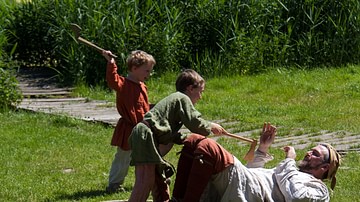
Childhood in the Viking Age
Childhood in the Viking Age (c. 750-1100) was largely undocumented as historical records primarily focus on adults, particularly men. Likewise, little is known about children's presence in the afterlife, as no runestones...

Definition
Erechtheion
The Erechtheion (or Erechtheum) is an ancient Greek temple constructed on the acropolis of Athens between 421 and 406 BCE in the Golden Age of the city in order to house the ancient wooden cult statue of Athena and generally glorify...

Definition
Parthenon - Temple of Athena Parthenos
The magnificent temple on the Acropolis of Athens, known as the Parthenon, was built between 447 and 432 BCE in the Age of Pericles, and it was dedicated to the city's patron deity Athena Parthenos. The temple...

Definition
Hephaistos
Hephaistos (Hephaestus) was the ancient Greek god of fire, metallurgy, and crafts. He was the brilliant blacksmith of the Olympian gods, for whom he fashioned magnificent houses, armour, and ingenious devices. Hephaistos had his workshop...

Article
The Olive in the Ancient Mediterranean
Olives and olive oil were not only an important component of the ancient Mediterranean diet but also one of the most successful industries in antiquity. Cultivation of the olive spread with Phoenician and Greek...
