
Search
Search Results
Definition
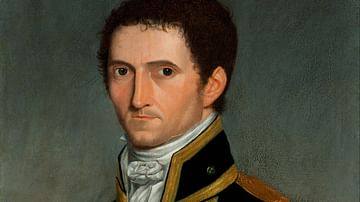
Matthew Flinders
Matthew Flinders (1774-1814) was an English navigator and hydrographer. He was the first person to map the coastal outline of Australia in 1801-1803, following his circumnavigation of the 7.692 million square kilometres (2.96 million square...
Article
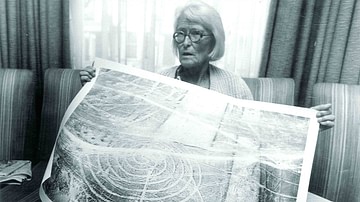
The Nazca Lines: A Life's Work
The World Heritage-listed Nazca lines are a well-known part of the ancient heritage of Peru. One woman spent over 50 years studying and protecting them. Ana Maria Cogorno Mendoza shares the story of Dr Maria Reiche. The lines and geoglyphs...

Definition
Portuguese Brazil
With a wealth of natural resources, Brazil was by far the most important colony in the Portuguese empire and was, at one time or another, the world’s leading producer of sugar, diamonds, and tobacco. Colonised from the 1530s, most settlements...

Definition
Spanish Main
The Spanish Main refers, in its widest sense, to the Spanish Empire in the Americas from Florida in the north to the northern coast of Brazil in the south, including the Caribbean. The term was initially more limited and referred only to...

Definition
Galleon
The galleon (Spanish: galeón, French: galion) was a type of sailing ship used for both cargo carrying and as a warship. Galleons dominated the seas in the second half of the 16th century, and with their lower superstructures, they were much...
Definition
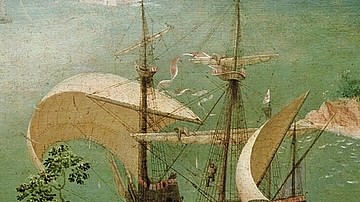
Carrack
The carrack (nao in Spanish, nau in Portuguese, and nef in French) was a type of large sailing vessel used for exploration, to carry cargo, and as a warship in the 15th and 16th centuries. Famous carracks include the Santa Maria of Christopher...

Article
The Seven Voyages of Zheng He
Admiral Zheng He (aka Cheng Ho, c. 1371-1433 CE) was a Chinese Muslim eunuch explorer who was sent by the Ming dynasty emperor Yongle (r. 1403-1424 CE) on seven diplomatic missions to increase trade and secure tribute from foreign powers...

Article
The Transatlantic Zeppelins - A Golden Age of Air Travel
Transatlantic Zeppelins carried passengers in relative luxury between Germany and New York or Rio de Janeiro during the 1920s and 1930s. The airships Graf Zeppelin and Hindenburg crossed the Atlantic in two or three days, faster than contemporary...

Article
Julius Caesar in Britain
By the time he led his invasions of Britain, Julius Caesar (100-44 BCE) was already an experienced politician and successful military commander. As a member of a patrician family which claimed a pedigree reaching back even earlier than the...

Article
Ancient Geography of India
The first text in Greek devoted entirely to India was written by Ctesias in the fourth century BCE. Only fragments of it survive. Yet he was probably the most widely quoted author on India, although Aristotle treated him with contempt. However...
