
Search
Remove Ads
Advertisement
Search Results

Article
Cylinder Seals in Ancient Mesopotamia - Their History and Significance
Among the most interesting and revealing artifacts discovered from ancient Mesopotamia are cylinder seals. These fairly small items may be seen today in museum exhibits around the world...

Article
Minoan Jewellery
The jewellery of the Minoan civilization based on Bronze Age Crete demonstrates, as with other Minoan visual art forms, not only a sophisticated technological knowledge (in this case of metalwork) and an ingenuity of design but...

Article
Turquoise in Mesoamerica
Turquoise was a highly-prized material in ancient Mesoamerica, perhaps the most valued of all materials for sacred and decorative art objects such as masks, jewellery, and the costumes of rulers and high priests. Turquoise...

Article
Minoan Stoneware
Craftsmen of the Minoan civilization centred on the island of Crete produced stone vessels from the early Bronze Age (c. 2500 BCE) using a wide variety of stone types which were laboriously carved out to create vessels of all...
Article
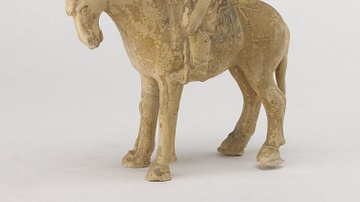
Archers in Ancient Chinese Warfare
The bow was the most common weapon in ancient Chinese warfare and the skill of using it was the most esteemed martial art for millennia. Archers were used as infantry, chariot riders, and cavalry over the centuries...
Article
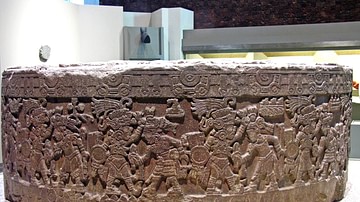
The Tizoc Stone
The Tizoc Stone is a huge stone cylinder from the Aztec capital of Tenochtitlan which depicts a sun-disk on its flat upper surface and carries a frieze around its outer edge showing Aztec warriors and the Aztec king Tizoc, whose...

Interview
Interview: Preclassic Maya
The genesis of Maya civilization in Mesoamerica was marked by an effervescence in the arts, the beginnings of their written language with glyphs, and a great attention to detail in the sphere of urban planning. Yet, despite...

Article
Cycladic Sculpture
The Cycladic islands of the Aegean were first inhabited by voyagers from Asia Minor around 3000 BCE and a certain prosperity was achieved thanks to the wealth of natural resources on the islands such as gold, silver, copper...

Article
Wine Culture in the Hellenistic Mediterranean
The culture of drinking wine was enjoyed throughout the Mediterranean world, and what is true now was true in antiquity, too: wine is always good business. The Hellenistic Period (c. 335-30 BCE), between...

Interview
Interview: Korea-Japan Relations Through the Prism of Archaeology
Ancient East Asia was dominated by the three states known today as China, Japan, and Korea. The complex chain of successive kingdoms created a rich web of events that archaeologists have...
