
Search
Remove Ads
Advertisement
Search Results

Image
Map of The Olmec World and Its Mesoamerican Connections - Power, Resources, and Interaction Networks, c. 1500–400 BCE
The Olmec world developed in the tropical lowlands of present-day Veracruz and Tabasco during Mesoamerica’s Formative period (c. 1500–400 BCE). Major...

Image
Aztec Warriors
Aztec warriors in typical costume of elite ranks with back racks displaying group insignia. They each carry an obsidian-bladed spear. From the Codex Mendoza, folio 67. (Bodleian Library, Oxford)

Image
Statue of King Sobekemsaf I or II
This is one of just a few surviving royal statues from the late Second Intermediate Period, when southern Egypt was ruled from Thebes. Two of its kings had the birth name of Sobekemsaf, but their order and chronological...

Image
Ehecatl, God of the Winds
A statue of Ehecatl, the Mesoamerican god of the Winds. The eyes are of obsidian and he wears his typical beaked mask. Aztec, Late Postclassic period. (National Museum of Anthropology, Mexico City)
Image
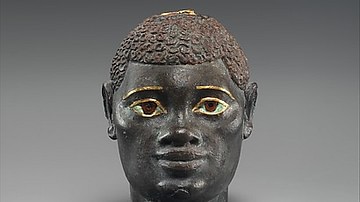
Hellenistic Head of an Aethiopian
This beautifully crafted head portrays an "Aethiopian", or black African, and is made out of black bronze, gold, obsidian and carnelian. The piece was once a part of an ornate object like a serving dish although...
Image
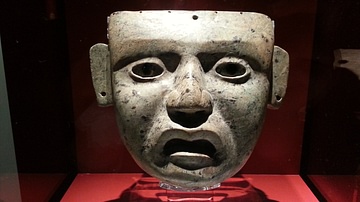
Teotihuacan Style Mask
This mask (900-1521 CE) is made of greenstone with obsidian eyes. Teotihuacan predated the Aztec civilisation by over 1,000 years. The Aztec's were curious archaeologists and they were impressed by the ruins of the civilisations...
Image
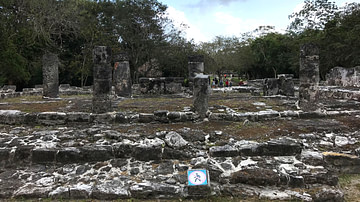
The Maya "Columns" Structure at San Gervasio
This Maya structure located on the Mexican island of Cozumel at the archaeological site of San Gervasio has seven columns, a bench running along the inner walls, and a throne or altar in the middle of the...
Image
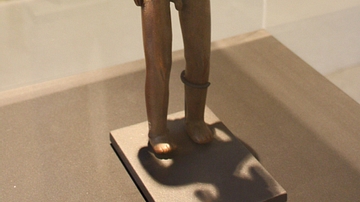
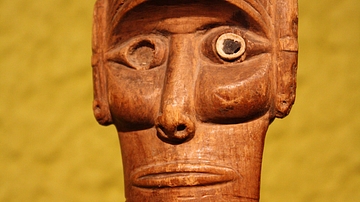
Moai Kavakava, Rapa Nui
Moai Kavakava, Rapa Nui (Easter Island). Wood, bone, and obsidian. 42.5 cm high. Collected in the 18th century CE. (Vatican Musems, Rome)
Image
Ua Staff, Rapa Nui
An Ua staff from Rapa Nui (Easter Island). Wood, bone, and obsidian. 1.49 m x 6.4 cm. Collected in the 18th century CE. (Vatican Museums, Rome)
Image
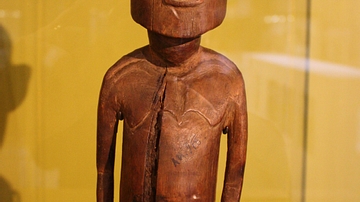
Moai Tangata, Rapa Nui
Moai tangata, Rapa Nui (Easter Island). Wood, bone, and obsidian. Collected in 1892 CE. Height: 46 cm. (Vatican Museums, Rome)
