
Search
Remove Ads
Advertisement
Search Results

Definition
Justinian I
Justinian I reigned as emperor of the Byzantine Empire from 527 to 565 CE. Born around 482 CE in Tauresium, a village in Illyria, his uncle Emperor Justin I was an imperial bodyguard who reached the throne on the death of Anastasius...
Definition
Mitla
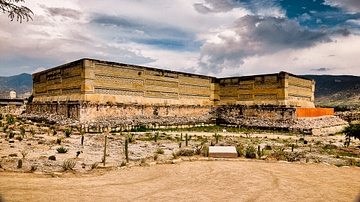
Mitla, located in the eastern portion of the Valley of Oaxaca in southern Mexico, was an important site of the Zapotec civilization. Gaining prominence from the early Post-Classic period (c. 700-900 CE), Mitla became the most important...

Definition
Picts
The Picts were a people of northern Scotland who are defined as a "confederation of tribal units whose political motivations derived from a need to ally against common enemies" (McHardy, 176). They were not a single tribe, nor necessarily...

Article
Kingdom of Magadha: Wars and Warfare
In ancient India from the 6th century BCE onwards, the kingdom of Magadha (6th century BCE to 4th century BCE) made a mark for itself. Located in the eastern part of India in what is today the state of Bihar, it...
Article
The Battle of the Catalaunian Fields
The Battle of the Catalaunian Fields (also known as The Battle of Chalons, The Battle of Maurica) was one of the most decisive military engagements in history between the forces of the Roman Empire under Flavius...

Article
Tacitus' Account of The Battle of Mons Graupius
The Battle of Mons Graupius was fought in 83 CE between the invading forces of Rome, under the general Agricola, and the Picts, the indigenous people of modern-day Scotland, under their leader Calgacus...

Image
Map of North Africa and the Western Mediterranean c. 1065 - Almoravids, Zirids, Hilalian Migrations & Norman Sicily
Around 1065, North Africa and the western Mediterranean were undergoing political fragmentation, migration, and the rise of new powers. The Zirids...

Article
Causes of the Hundred Years' War
The Hundred Years' War (1337-1453) was an intermittent conflict fought between England and France that started when king Edward III of England (r. 1327-1377) squabbled with Philip VI of France (r. 1328-1350) over...

Article
Interview: Medieval Christian Art in the Levant
Medievalists retain misconceptions and myths about Oriental Christians. Indeed, the fact that the Middle East is the birthplace of Christianity is an afterthought for many. During the Middle Ages, Christians...

Image
The Seven Sacks of Rome (390 BCE–1527 CE) - Invasions, Civil Wars, and Rome's Transformation
Across nearly two millennia, the city of Rome was repeatedly captured and plundered as its political position changed from the capital of an expanding republic to the...
