
Search
Remove Ads
Advertisement
Search Results

Article
7 Ancient Sites in Georgia
Georgia, lying at the junction of Europe and Asia, is a country of ancient myths with a rich and turbulent history. Home to the first European hominids and the birthplace of wine, Georgia's roots trace back to ancient civilisations. Throughout...

Article
The Athenian Calendar
The term “Athenian Calendar” (also called the “Attic Calendar”) has become somewhat of a misnomer, since Ancient Athenians never really used just one method to reckon the passage of time. Athenians, especially from the 3rd Century BCE forward...

Article
The Sun & the Moon in Norse Myth
In Norse mythology, the Sun and the Moon appear as personified siblings pulling the heavenly bodies and chased by wolves, or as plain objects. Written sources, such as the Poetic Edda and the Prose Edda, have surprisingly little to say about...

Article
Early Explorers of the Maya Civilization: John Lloyd Stephens and Frederick Catherwood
The names of John Lloyd Stephens and Frederick Catherwood are forever linked to the Maya and Mayan studies as the two great explorers who documented the ruins from Copan in the south to Chichen Itza in the north. The stories told by Stephens...

Article
Naval Warfare in Ancient India
The navy in ancient India carried out three roles: it was used to transport troops to distant battlefields, participate in actual warfare, and was primarily meant for protecting the kingdom's trade on sea and navigable rivers and the maritime...

Article
Colonial American Currency
Colonial American currency was a work in progress from the time of the earliest English settlements of the 1600s until the United States of America minted its own money in 1783. The monetary system was far from standardized, and trade within...
Article
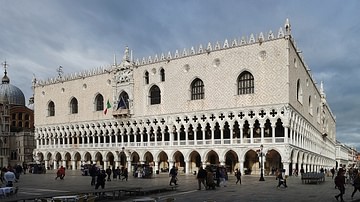
Doge's Palace in Venice
The Doge's Palace, or Palazzo Ducale, in Venice, Italy, was the seat of power of one of the world's most powerful city-states, as the Venetian Republic dominated the Mediterranean for centuries. The bright façade of the palace marks the very...

Article
Exploring Roman Morocco
Morocco, then known as Mauretania, was annexed by the Roman Empire in 40 CE. The Romans in Morocco left a vast legacy with archaeological sites that dot the country's northern landscape, especially Volubilis, with its vestiges of Roman houses...

Article
Hanno: Carthaginian Explorer
In the 5th century BCE, the Carthaginian explorer Hanno sailed beyond the Pillars of Hercules, out of the Mediterranean and into hitherto unknown territory down the Atlantic coast of Africa. In his search to find new resources and trading...
Article
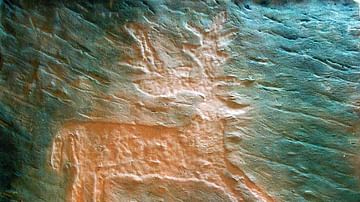
Rock Drawings of Valcamonica
The rock drawings of Valcamonica are prehistoric petroglyphs carved in the glacier-polished, grey-purple Permian sandstone of the Camonica valley that extends for 90 km in the Italian provinces of Brescia and Bergamo in Lombardy. The name...
