
Search
Remove Ads
Advertisement
Search Results

Definition
Christiaan Huygens
Christiaan Huygens (1629-1695) was a Dutch mathematician, physicist, and astronomer. A leading figure of the Scientific Revolution, Huygens combined research into mathematical-based theories, such as the movement of light waves, with practical...

Definition
Heinkel He 111
The Heinkel He 111 was a medium two-engined bomber plane used by the German Air Force (Luftwaffe) during the Second World War (1939-45). Heinkel He 111s contributed significantly to such campaigns as the Battle of France, the Battle of Britain...

Definition
SS Great Eastern
The SS Great Eastern was a steam-powered ship designed by Isambard Kingdom Brunel (1806-1859) which sailed on its maiden voyage from Liverpool to New York in June 1860. At the time, it was by far the largest passenger ship ever built, a record...

Definition
Junkers Ju 88
The Junkers Ju 88 was a two-engined medium bomber plane used by the German Air Force (Luftwaffe) throughout the Second World War (1939-45). Ju 88s were involved in the Battle of Britain and London Blitz as bombers, but this versatile aircraft...
Definition
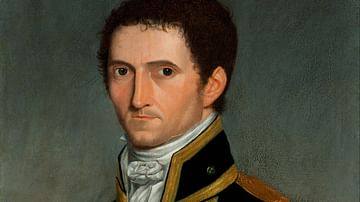
Matthew Flinders
Matthew Flinders (1774-1814) was an English navigator and hydrographer. He was the first person to map the coastal outline of Australia in 1801-1803, following his circumnavigation of the 7.692 million square kilometres (2.96 million square...

Article
The Phoenicians - Master Mariners
Driven by their desire for trade and the acquisition of such commodities as silver from Spain, gold from Africa, and tin from the Scilly Isles, the Phoenicians sailed far and wide, even beyond the Mediterranean's traditional safe limits of...

Article
Astronomy in the Scientific Revolution
The astronomers of the Scientific Revolution rejected long-held theories of ancient thinkers like Claudius Ptolemy and Aristotle and instead set out to systematically observe the heavens in order to create a model of the universe that fit...
Article
On the Ocean: The Famous Voyage of Pytheas
Sometime around 330 BCE, Pytheas, a little-known Greek merchant, embarked on an astonishing voyage. It was a voyage that would take him far beyond the known boundaries of the Mediterranean, into lands thought to exist only in myth and legend...

Article
Clocks in the Scientific Revolution
Keeping good time proved an elusive objective for centuries, and it was only in the second half of the 17th century, during the Scientific Revolution (1500-1700), that clocks were made which lost seconds rather than minutes each day. The...

Article
Observatories in the Scientific Revolution
The foundation of observatories during the Scientific Revolution (1500-1700) followed a process of evolution from entirely independent observatories operated by a single astronomer to private observatories which received state or private...
