
Search
Remove Ads
Advertisement

 This answer was generated by
 Search Results

Definition
Nebuchadnezzar II
Nebuchadnezzar II (r. 605/604-562 BCE) was the greatest King of ancient Babylon during the period of the Neo-Babylonian Empire (626-539 BCE), succeeding its founder, his father, Nabopolassar (r. 626-605 BCE). He is best known...
Image
Chronicle of Nabopolassar
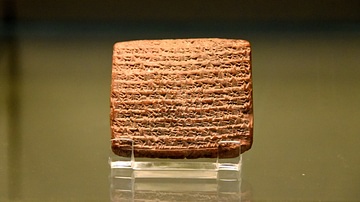
The cuneiform inscriptions on this clay tables narrates the chronicle of the years 608-605 BCE. Nabopolassar (reigned 658-605 BCE) was the king of Babylon and the father of Nebuchadnezzar II. After the fall of Nineveh...

Image
Terracotta Cylinder of the Babylonian King Nabopolassar
This document records the king’s reconstructive work on the wall of the city of Babylon. From Babylon (modern Babel governorate), neo-Babylonian era, 625-605 BCE, Mesopotamia, Iraq. (The British...

Definition
Babylon - The Gate of the Gods
Babylon is the most famous city from ancient Mesopotamia, whose ruins lie in modern-day Hillah, Iraq, 59 miles (94 km) southwest of Baghdad. The name is derived from bav-il or bav-ilim, which in Akkadian meant "Gate...

Image
Clay Cover of the Tablet of Shamash (II)
This is a fired clay cover of the sun god (Shamash) tablet. Its purpose was to protect the obverse side (face) of the tablet. It has retained the impression of the carved panel of the tablet. The Babylonian...

Definition
Mesopotamian Government - Helping and Serving the Gods
Ancient Mesopotamian government was based on the understanding that human beings were created to help and serve the gods. The high priest, king, assembly of elders, governors, and any other officials...

Definition
Hanging Gardens of Babylon
The Hanging Gardens of Babylon were the fabled gardens which beautified the capital of the Neo-Babylonian Empire, built by its greatest king Nebuchadnezzar II (r. 605-562 BCE). One of the Seven Wonders of the Ancient World...

Definition
Ishtar Gate
The Ishtar Gate was constructed by the Babylonian King Nebuchadnezzar II circa 575 BCE. It was the eighth gate of the city of Babylon (in present-day Iraq) and was the main entrance into the city. The Ishtar Gate was part of Nebuchadnezzar's...

Definition
Medes
The Medes or Medians were a group of Indo-Iranian-speaking people from central Asia who migrated westwards and entered northern Iran around the end of the 2nd millennium BCE. They settled in the highlands of Zagros (Zagreus in Greek...

Article
Mesopotamian Effects on Israel During the Iron Age
The Iron Age in the traditional Ancient Near Eastern chronology ranges from somewhere around 1200 BCE to 333 BCE. It begins from the era when it was first thought iron came to be used up to the ascendency...
