
Search
Remove Ads
Advertisement
Search Results

Article
Pizarro & the Fall of the Inca Empire
In 1533 CE the Inca Empire was the largest in the world. It extended across western South America from Quito in the north to Santiago in the south. However, the lack of integration of conquered peoples into that...

Interview
Rubin Museum's Faith and Empire: Tibetan Buddhist Art
Faith and Empire: Art and Politics in Tibetan Buddhism, a new exhibition at the Rubin Museum of Art in New York, explores the dynamic historical intersection of politics, religion, and art as reflected...

Article
Gibbon's Decline & Fall of the Roman Empire
The English historian Edward Gibbon (1737-1794) wrote and published his seminal work History of the Decline and Fall of the Roman Empire between 1776 and 1788. The dominant theme of Gibbon's six-volume work...

Article
Bureaucracy in the Achaemenid Empire: Learning from the Past
In the early days of the Achaemenid Empire (c. 550-330 BCE), the kings came to realise that, if they were to be able to administer the vast mass of land and the multicultural people who inhabited...

Video
Looking East, Looking West: Mughal Painting between Persia and Europe
Looking East, Looking West: Mughal Painting between Persia and Europe November 19, 2015 Getty Center Lecture by Kavita Singh Introductory remarks by Thomas W. Gaehtgens and Brian...

Video
Mughal Miniature, the Padshahnama
In this short film, Emily Hannam discusses a pair of mid-seventeenth century paintings by the Mughal court artists Bichitr and Ramdas from the most famous South Asian manuscript in the Royal Collection, the Padshahnama...

Image
Mughal Princess Reclining on a Terrace with Attendants
A princess reclining on a terrace with attendants, gum tempera and gold on paper, Mughal Empire, India, c. 1730-1740. The Cleveland Museum of Art, Gift in honor of Madeline Neves Clapp; Gift of...

Image
18th-century Mughal Miniature Quran
A miniature Qur'an in vellum binding. Mughal Empire, 18th century. (Victoria and Albert Museum, London)
Image
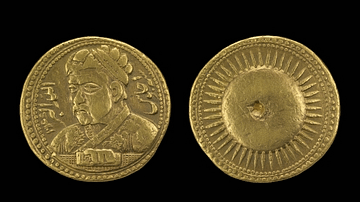
Mughal Gold Coin of Emperor Akbar
A gold mohur coin issued by Mughal Emperor Jahangir (r. 1605-28) bearing a portrait of his Father, Akbar. The coin was issued in 1605, the first year of Jahangir's reign. The inscription in Arabic next to the portrait...

Definition
Portuguese Empire
The Portuguese Empire was established from the 15th century and eventually stretched from the Americas to Japan. Very often a string of coastal trading centres with defensive fortifications, there were larger territorial colonies...
