
Search
Remove Ads
Advertisement
Search Results

Definition
East India Company
The English East India Company (EIC or EEIC), later to become the British East India Company, was founded in 1600 as a trading company. With a massive private army and the backing of the British government, the EIC looted the...

Definition
Ancient Persia
Persia (roughly modern-day Iran) is among the oldest inhabited regions in the world. Archaeological sites in the country have established human habitation dating back 100,000 years to the Paleolithic Age with semi-permanent settlements...

Image
Holi Celebration in the Mughal Period
Krishna and the gopis celebrate Holi, watercolour painting, c. 1765. Holi is a festival of spring, of colours, and of happiness. This image depicts Holi being celebrated in the Mughal era. Royal Collection Trust...

Definition
Seleucid Empire
The Seleucid Empire (312-63 BCE) was the vast political entity established by Seleucus I Nicator ("Victor" or "Unconquered", l. c. 358-281 BCE, r. 305-281 BCE), one of the generals of Alexander the Great who claimed a part of...

Definition
Achaemenid Empire
East of the Zagros Mountains, a high plateau stretches off towards India. While Egypt was rising up against the Hyksos, a wave of pastoral tribes from north of the Caspian Sea was drifting down into this area and across into...
Image
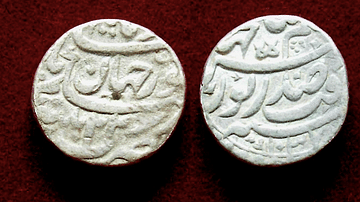
Mughal Coin of Nur Jahan
Silver Mughal coin bearing the name of Queen Nur Jahan (c. 1577-1645), wife of the Mughal Emperor Jahangir (r. 1605-1627).

Definition
Mongol Empire
The Mongol Empire (1206-1368) was founded by Genghis Khan (r. 1206-1227), first Great Khan or 'universal ruler' of the Mongol peoples. Genghis forged the empire by uniting nomadic tribes of the Asian steppe and creating a devastatingly...

Definition
Henry Every
Henry Every (b. 1653), also known as Henry Avery, Benjamin Bridgeman, ‘Long Ben’ and (incorrectly) John Avery, was one of the most savage and successful pirates in the Golden Age of Piracy. Capturing a treasure ship of the Mughal...

Definition
Gupta Empire
The Gupta Empire stretched across northern, central and parts of southern India between c. 320 and 550 CE. The period is noted for its achievements in the arts, architecture, sciences, religion, and philosophy. Chandragupta I (320...

Article
Fall of the Western Roman Empire
To many historians, the fall of the Western Roman Empire in the 5th century CE has always been viewed as the end of the ancient world and the onset of the Middle Ages, often improperly called the Dark Ages, despite...
