
Search
Remove Ads
Advertisement
Search Results

Definition
Geoffrey Chaucer
Geoffrey Chaucer (l. c. 1343-1400 CE) was a medieval English poet, writer, and philosopher best known for his work The Canterbury Tales, a masterpiece of world literature. The Canterbury Tales is a work of poetry featuring a group...

Definition
Bantu Migration
The Bantu migration from their origins in southern West Africa saw a gradual population movement sweep through the central, eastern, and southern parts of the continent starting in the mid-2nd millennium BCE and finally ending...

Definition
Merlin
Merlin (also known as Myrddin, Merlinus) is the great wizard of the Arthurian Legends best known from Sir Thomas Malory's Le Morte D'Arthur (1469 CE). The character was created by Geoffrey of Monmouth in his History of the Kings of Britain...

Definition
Kinkakuji
Kinkakuji Temple in Kyoto, Japan, more formally referred to as Rokuon-ji or 'Deer Garden Temple' and otherwise known as 'The Temple of the Golden Pavilion', was first built in 1397 CE. Originally the retirement residence of the shogun...
Definition
Ryoanji
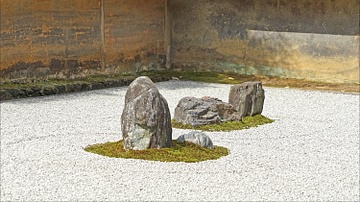
Ryoanji (Ryōan-ji) is a Zen Buddhist temple in Kyoto, Japan which is today most famous for its Zen rock garden with its enigmatic arrangement of stones. Founded in the 15th century CE, the temple is one of the most visited tourist spots...

Definition
Oda Nobunaga
Oda Nobunaga was the foremost military leader of Japan from 1568 to 1582. Nobunaga, along with his two immediate successors, Toyotomi Hideyoshi (1537-1598) and Tokugawa Ieyasu (1543-1616), is credited with unifying medieval Japan...

Definition
Sengoku Period
The Sengoku Period (Sengoku Jidai, 1467-1568 CE), also known as the Warring States Period, was a turbulent and violent period of Japanese history when rival warlords or daimyo fought bitterly for control of Japan. The period falls...

Definition
Gurjara-Pratihara Empire
The Gurjara-Pratiharas, or simply, the Pratiharas (8th century CE - 11th century CE) held their sway over western and northern India. This dynasty saw its fortunes rising under Nagabhata I (730–760 CE) who successfully...

Definition
Yurt
A yurt (ger in Mongolian) is a large circular tent made of wool felt stretched over a wooden frame used by nomadic peoples of the Asian steppe since before written records began. Yurts are especially associated with Mongol herders and...

Definition
Möngke Khan
Mongke Khan was ruler of the Mongol Empire (1206-1368 CE) from 1251 to 1259 CE. As the third Great Khan or 'universal ruler' of the Mongols, Mongke would oversee administrative reforms that continued to centralise government and ensure...
