
Search
Remove Ads
Advertisement
Search Results

Collection
Daily Life in a Medieval Monastery
Monasteries and other religious institutions such as priories and nunneries were a quintessential part of the medieval landscape and an important component of a community's social fabric. Providing spiritual guidance...

Article
The Household Staff in an English Medieval Castle
An English medieval castle, if a large one, could have a household staff of at least 50 people, which included all manner of specialised and skilled workers such as cooks, grooms, carpenters, masons...
Image
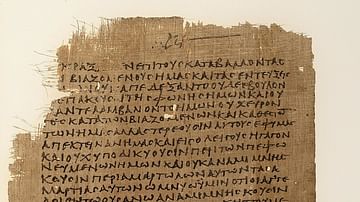
The Book of Enoch Manuscript
The backside of P.Mich.inv. 5552, showing portions of the Book of Enoch in Greek. Part of the Chester Beatty Papyri, most likely originated in Egypt, 4th century CE.
University of Michigan, Ann Arbor Library

Image
Illuminated Manuscript of the Rubaiyat
The Rubaiyat of Omar Khayyam (l. 1048-1131 CE), illuminated by William Morris.

Image
Buddhist Illuminated Manuscript, Goryeo Period
An illuminated text of the Buddhist Lotus sutra. Goryeo period (918-1392 CE).
Gwangdeoksa temple in Chenan, Korea.
Image
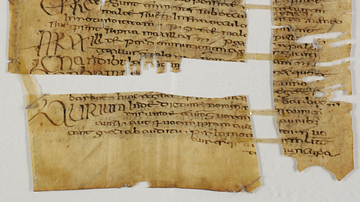
Irish Manuscript Fragment
This Isidor fragment from the middle of the 7th century CE shows how the Irish introduced capital letters at the beginnings of paragraphs, the separation of words from each other, and interpunction into writing; all innovations...

Article
Martial Arts in Medieval Japan
There were 18 martial arts (bugei or bujutsu) in medieval Japan, and these included use of weapons, unarmed self-defence techniques, swimming, and equestrian skills. Initially designed to hone the skills of warriors...

Article
Diversity in Church Architecture in Medieval England
Medieval English churches differed in size and layout. Their original and evolving role(s), financial and material resources, and architectural fashions helped determine variability. However, their...

Article
Medieval Indulgence & Martin Luther
The medieval indulgence was a writ offered by the Church, for money, guaranteeing the remission of sin, and its abuse was the spark that inspired Martin Luther's 95 Theses. Luther (l. 1483-1546) claimed the sale...

Collection
Life in a Medieval Castle
Protecting strategically important coastlines, passes, and roadways, castles were an essential part of medieval warfare. With such key features as a tower keep, fortified gatehouses, curtain walls with crenellations and...
