
Search
Remove Ads
Advertisement
Search Results

Definition
Oda Nobunaga
Oda Nobunaga was the foremost military leader of Japan from 1568 to 1582. Nobunaga, along with his two immediate successors, Toyotomi Hideyoshi (1537-1598) and Tokugawa Ieyasu (1543-1616), is credited with unifying medieval Japan...

Definition
Hundred Years' War
The Hundred Years' War (1337-1453) was an intermittent conflict between England and France lasting 116 years. It began principally because King Edward III (r. 1327-1377) and Philip VI (r. 1328-1350) escalated a dispute over...

Definition
David IV the Builder
David IV the Builder or the Restorer (also known as Davit IV Aghmashenebeli) was the king of Georgia from 1089 to 1125 CE. His long reign was marked by a substantial revival of medieval Georgia, he regained much of Georgia's...
Definition
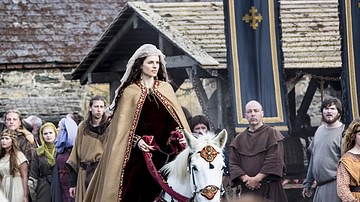
Cwenthryth of Mercia
Cwenthryth of Mercia (also given as Cwoenthryth, 9th century CE) was the daughter of King Coenwulf (r. 796-821 CE). Little is known of her actual life but she later became infamous in the 12th century CE through the legend...

Definition
Renaissance Architecture
Renaissance architecture originated in Italy and superseded the Gothic style over a period generally defined as 1400 to 1600. Features of Renaissance buildings include the use of the classical orders and mathematically...

Definition
Samhain
Samhain (pronounced “SOW-in” or “SAH-win”), was a festival celebrated by the ancient Celts halfway between the autumn equinox and the winter solstice. It began at dusk around October 31st and likely lasted three days. Samhain marked...

Definition
Book of Kells
The Book of Kells (c. 800) is an illuminated manuscript of the four gospels of the Christian New Testament, currently housed at Trinity College, Dublin, Ireland. The work is the most famous of the medieval illuminated manuscripts...

Definition
Henry II of England
Henry II of England ruled from 1154 to 1189 CE. He gained the throne by negotiation with his predecessor King Stephen of England (r. 1135-1154 CE) following the civil war that had raged between that monarch and Henry's mother...

Definition
Genghis Khan
Genghis Khan (aka Chinggis Khan) was the founder of the Mongol Empire which he ruled from 1206 until his death in 1227. Born Temujin, he acquired the title of Genghis Khan, likely meaning 'universal ruler’, after unifying the Mongol...
Definition
Leprechaun
Leprechauns (also leprecauns or lepracauns) are figures in Irish folklore who guard hidden treasure. Regarded as small and incredibly agile male fairies or goblins, they most often guard a pot of gold. Leprechauns live solitary lives...
