
Search
Remove Ads
Advertisement
Search Results

Article
Global Trade in the 13th Century
In the 13th century, astonishing quantities of spices and silk passed from the Far East to Europe. Exact amounts are not known, but spice popularity in both cuisine and medicine reached its historical peak during...

Definition
Geghard
Geghard (Armenian: Geghardavank or "monastery of the spear") is a medieval monastery located in Armenia's Kotayk province, deep within the Azat Valley, which was built directly out of an adjacent mountain. Geghard is renown throughout...

Definition
Shogun
The shoguns of medieval Japan were military dictators who ruled the country via a feudal system where a vassal's military service and loyalty was given in return for a lord's patronage. Established as an institution by the first shogun...

Definition
Japanese Tea Ceremony
The Japanese Tea Ceremony (chanoyu or chado) is a cultural tradition involving very particular places, procedures, and equipment for drinking green tea. Originating as a habit of Chinese Buddhist monks to aid their meditation...

Definition
Knights Hospitaller
The Knights Hospitaller was a medieval Catholic military order founded in 1113 CE with the full name of 'Knights of the Order of the Hospital of Saint John of Jerusalem'. After their base was relocated to Rhodes in the early...

Definition
Imhotep
Imhotep (Greek name, Imouthes, c. 2667-2600 BCE) was an Egyptian polymath (a person expert in many areas of learning) best known as the architect of King Djoser's Step Pyramid at Saqqara. His name means "He Who Comes in Peace" and he...

Definition
Giovanni Boccaccio
Giovanni Boccaccio (1313-1375) was an Italian poet, writer, and scholar. His most famous and influential work is the Decameron, completed by 1353, in which his ten characters present 100 tales of everyday life. The book covers...

Definition
Roman Science
The Romans assimilated earlier Greek science for their own purposes, evaluating and then accepting or rejecting that which was most useful, much as they did in other fields such as warfare, art, and theatre. This assimilation of...
Article
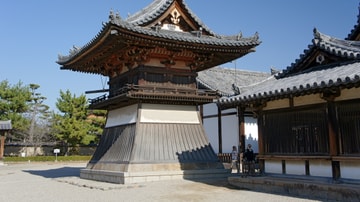
Life in a Japanese Buddhist Monastery
Buddhist monasteries have been part of the Japanese cultural landscape ever since the 7th century CE, and they remained both powerful and socially important institutions right through the medieval period. Today...

Definition
Dissolution of the Monasteries
The Dissolution of the Monasteries was a policy introduced in 1536 CE by Henry VIII of England (r. 1509-1547 CE) to close down and confiscate the lands and wealth of all monasteries in England and Wales. The plan was...
