
Search
Remove Ads
Advertisement
Search Results

Image Gallery
A Gallery of Maya Cities
The Maya Civilization flourished between 250-950 although it drew upon earlier civilizations such as that of the Olmecs (1500 - 200 BCE) and Zapotec (600 BCE - 800 CE) and lasted through the Post-Classic Period of 950-1524...

Definition
Tikal
Tikal, located in the north of the Petén region of Guatemala, was a major Maya city which flourished between 300 and 850 CE. The city, known to the Maya themselves as Mutul, is one of the grandest in Mesoamerica. Amongst the first Maya...

Definition
Uxmal
Uxmal, in north-west Yucatán, Mexico, was an important Maya city which flourished between the 6th and 10th centuries CE. The city, following an extensive restoration programme, is the best preserved of all Maya sites, and it possesses...

Collection
Maya Religion & Culture
Maya religion and culture is among the most advanced and sophisticated of the Pre-Colombian Americas as evidenced by the ruins of their great cities and what remains of their writings after most were burned by the Spanish...

Definition
K'inich Janaab' Pakal
K'inich Janaab' Pakal (23 March 603 CE - 31 March 683 CE) was the Maya king of Palenque in the modern-day State of Chiapas, Mexico. Also known as Pacal (which means 'shield') and Pacal the Great, he is most famous for raising...
Image
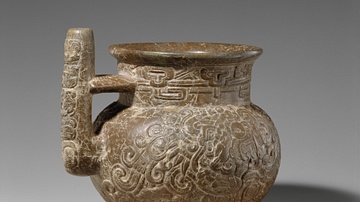
Maya Spouted Jar
This spouted vessel is one of the most elegantly sculpted stone containers in the corpus of Maya art. Its form with the vertical spout parallel to the central axis of the main chamber is known from the late 1st millennium B.C...
Image
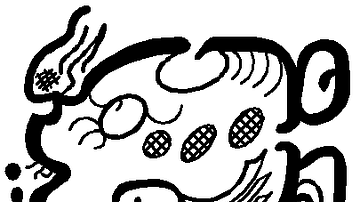
Maya kakau glyph
This ancient Maya glyph is pronounced "kah-kah-oo." Various forms of this glyph can be found on Maya vessels, some of which are known to have contained chocolate in some form.

Video
The Maya Calendar, Culture and History: an Introduction to a Mesoamerican Civilization
The Maya are a people indigenous to Mexico and Central America who have continuously inhabited the modern regions of Yucatan, Quintana Roo, Campeche, Tabasco, and Chiapas...

Definition
Copan
Copán (in modern Honduras) is located on the floodplain of the river of the same name. It was the most southerly of the Classic Maya centres and, at an altitude of 600 metres, the highest. Copán reached the height of its power in the...

Definition
Religion in the Ancient World - Order and the Spiritual Experience
Religion (from the Latin Religio, meaning "restraint," or Relegere, according to Cicero, meaning "to repeat, to read again," or, most likely, Religionem, "to show respect for what is sacred"...
