
Search
Remove Ads
Advertisement
Search Results

Definition
Kukulcan - The Feathered-Serpent God of Mesoamerica
Kukulcan (pron. Koo-kool-kan) is the name of a feathered serpent god in the mythology and religion of Mesoamerica, in particular, the Yucatec Maya. He is also identified as the feathered serpent god...

Definition
Xibalba
Xibalba (Shee-bal-ba) was the name the K'iche Maya gave to the underworld. For the Yucatec Maya the underworld was known as Metnal. The name Xibalba translates as 'Place of Fright', which indicates the terror the place had in the Maya...

Definition
Popol Vuh
The Popol Vuh is the story of creation according to the Quiche Maya of the region known today as Guatemala. Translated as `The Council Book', The Book of the People' or, literally, `The Book of the Mat', the work has been referred...
Image
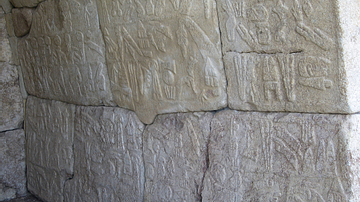
Luwian Hieroglyphs in Hattusa
Luwian Hieroglyphs in Hattusa (the capital of the Hittite Empire) which adorned a chamber perhaps representing a symbolic entrance to the Underworld. The chamber was commissioned by Suppiluliuma II (1207–1178 BCE...

Article
Jade in Mesoamerica
Jade was a highly-esteemed material in many Mesoamerican cultures, making it a valued regional trade good and first choice for objects of religious and artistic value such as masks, ceremonial axeheads, figurines, and jewellery...

Definition
Lumbini
Lumbini is a village, archaeological site, and place of pilgrimage honored as the birthplace of Siddhartha Gautama (the Buddha, l. c. 563-483 BCE) located in modern-day Rupandehi District of Nepal, Province 5, near the Indian border...
Image
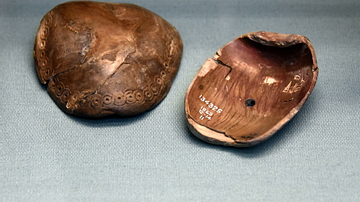
Shell Clappers with Luwian Hieroglyphs
These musical instruments were given to the Assyrian king Shalmaneser III (reigned 858-824 BCE) by the king of Hamath (now Hama) in Syria. His name, Urhilina, appears in Luwian hieroglyphs on the underside of...

Definition
K'inich Yax K'uk' Mo
Yax K'uk' Mo' (pronounced `Yash Kook Mo') was the founder and first king of the dynasty that ruled the Maya city of Copan (in modern day Honduras) for 350 years. Known formally by his royal name, K'inich Yax K'uk' Mo', he...

Definition
Chichen Itza
Chichen Itza, located at the northern tip of the Yucatán Peninsula of modern Mexico, was a Maya city which was later significantly influenced by the Toltec civilization. Flourishing between c. 750 and 1200 CE, the site is rich in...

Article
Dogs and Their Collars in Ancient Mesoamerica
Dogs were an integral aspect of the lives of the people of Mesoamerica regardless of their location or culture and, throughout the region, were recognized as liminal beings belonging not only to the natural...
