
Search
Did you mean: Inca Art?
Remove Ads
Advertisement
Search Results
Definition
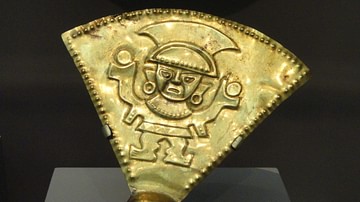
Chimu Civilization
The Chimu civilization, otherwise called the kingdom of Chimor, flourished on the northern coast of Peru between the 12th and 15th centuries CE. With their capital at Chan Chan, the Chimu were the largest and most prosperous...

Definition
Unified Silla Kingdom
The Unified Silla Kingdom (668- 935 CE) was the first dynasty to rule over the whole of the Korean peninsula. After centuries of battles with the other states of the Three Kingdoms Period (57 BCE - 668 CE) Silla benefitted...

Definition
Hinduism
Hinduism is the oldest religion in the world, originating in Central Asia and the Indus Valley, still practiced in the present day. The term Hinduism is what is known as an exonym (a name given by others to a people, place, or concept...

Definition
Columbian Exchange
The Columbian exchange is a term coined by Alfred Crosby Jr. in 1972 that is traditionally defined as the transfer of plants, animals, and diseases between the Old World of Europe and Africa and the New World of the Americas...

Definition
Tairona Civilization
The Tairona civilization - one of the Chibcha family tribes - flourished in northern Colombia between 200 CE and 1600 CE. Like the Muisca of Cundinamarca, the Tairona were known for their expertise in crafting and metallurgy...

Definition
Quetzalcóatl
Quetzalcóatl (pron. Quet-zal-co-at) or 'Plumed Serpent' was one of the most important gods in ancient Mesoamerica. Quetzalcóatl was the god of winds and rain, and the creator of the world and humanity. A mix of bird and rattlesnake...

Definition
Ehecatl
Ehecatl was a Mesoamerican god of air and winds, especially those which brought rains. Regarded as a manifestation of the great feathered serpent god Quetzalcoatl, he was sometimes known as Quetzalcoatl-Ehecatl, in which guise he helped...

Definition
Spanish Treasure Fleets
From the 16th to 18th centuries, two treasure fleets sailed each year, one to Mexico and the other to Central America, then part of the Spanish Empire. There they collected precious eastern goods and the riches of the Americas...
Definition
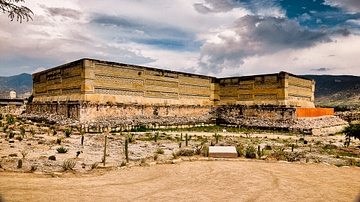
Mitla
Mitla, located in the eastern portion of the Valley of Oaxaca in southern Mexico, was an important site of the Zapotec civilization. Gaining prominence from the early Post-Classic period (c. 700-900 CE), Mitla became the most important...

Definition
Sofonisba Anguissola - The Founder of Feminist Art
Sofonisba Anguissola (c. 1532-1625) was an Italian Renaissance painter from Cremona who achieved considerable fame during her lifetime as the first widely-known female artist. She was invited by the...
