
Search
Did you mean: Arrian?
Remove Ads
Advertisement
Search Results

Definition
Leptis Magna
Leptis Magna (aka Lepcis Magna), located in western Libya, North Africa, was a Phoenician city founded by Tyre in the 7th century BCE. Continuing to be a major city in the Roman period, it was the birthplace of Emperor Septimius...

Definition
Nanshe - The Selfless Sumerian Goddess of Social Justice
Nanshe (also known as Nanse, Nazi) is the Sumerian goddess of social justice and divination, whose popularity eventually transcended her original boundaries of southern Mesopotamia toward all points...
Definition
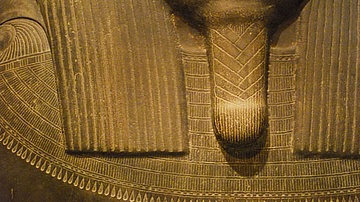
Eshmunazar II
Eshmunazar II (also Eshmunazor II) was a king of the Phoenician city of Sidon during the Persian period. He was the third king of his family, after his his father and his grand-father. He was the son of Tabnit and Amashtart, and...

Definition
Heka
Heka is the god of magic and medicine in ancient Egypt and is also the personification of magic itself. He is probably the most important god in Egyptian mythology but is often overlooked because his presence was so pervasive as to make...

Definition
Pyrrhus - The King with Costly Victories
Pyrrhus (also Pyrrhos or Phyrrhus, c. 319 - 272 BCE ) was the king of Epirus in northern Greece between 306 and 302 BCE and again between 297 and 272 BCE. Winning great victories against the armies of Macedon...

Definition
Edda
Edda is a term used to describe two Icelandic manuscripts that were copied down and compiled in the 13th century CE. Together they are the main sources of Norse mythology and skaldic poetry that relate the religion, cosmogony, and history...

Definition
Archimedes
Archimedes (l. 287-212 BCE) was a Greek engineer and inventor who is regarded as the greatest mathematician of antiquity and one the greatest of all time. He is credited with a number of inventions still in use today (such as the...
Definition
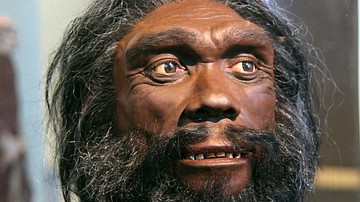
Homo Heidelbergensis
Homo heidelbergensis is an extinct species of human that is identified in both Africa and western Eurasia from roughly 700,000 years ago onwards until around 200,000 years ago – fitting snugly within the Middle Pleistocene...

Definition
Isthmia
Isthmia is a genitive noun with the meaning 'of the Isthmus.' It generally refers to the site that held the famous Isthmian Games near Corinth on the Isthmus. A natural assembly place for many Greeks and travellers. Isthmia in Antiquity...

Definition
Manyoshu
The Manyoshu or 'Collection of Ten Thousand Leaves' is an anthology of ancient Japanese poems compiled c. 759 CE during the Nara Period but including many earlier works. The most likely person to have assembled the collection is Otomo...
