
Search
Remove Ads
Advertisement
Search Results

Article
The Armies of the Crusades
The armies of the Crusades (11th-15th centuries CE), which saw Christians and Muslims struggle for control of territories in the Middle East and elsewhere, could involve over 100,000 men on either side who came from all...
Image
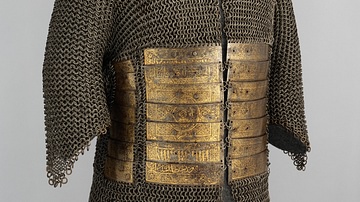
Armour of Sultan Qaitbay
A shirt of chainmail and plate armour belonging to Sultan Qaitbay (r. 1468–1496 CE) of the Mamluk Sultanate. The mail is made of iron and copper alloy. The gold-damascened steel plates are intricately engraved with scrolling...
Image
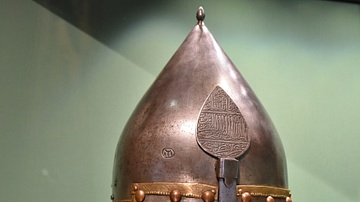
Helmet of Sultan Qaitbay
A helmet belonging to Sultan Qaitbay (r. 1468–1496 CE) of the Mamluk Sultanate. Collection of the State Hermitage Museum, St. Petersburg.

Image
Map of Ibn Battuta’s Travels, 1325-1354 - Medieval Travel, Scholarship & Connectivity in Afro-Eurasia
Ibn Battuta ((Abū Abd Allāh Muḥammad ibn Abd Allāh Al-Lawātī, 1304–c. 1368 CE) was a traveler, jurist, and scholar from Tangier whose journeys across Afro-Eurasia...

Definition
Razia Sultan - The First Female Muslim Ruler of India
Sultan Razia (Raziyyat-Ud-Dunya Wa Ud-Din, r. 1236-1240) was one of the few women rulers in the Indian subcontinent and the first and only female Sultan of Delhi. Despite facing Herculean challenges...

Definition
Seventh Crusade
The Seventh Crusade (1248-1254 CE) was led by the French king Louis IX (r. 1226-1270 CE) who intended to conquer Egypt and take over Jerusalem, both then controlled by the Muslim Ayyubid Dynasty. Despite the initial success of...

Definition
Old Dongola
Old Dongola (aka Dungulah or Dunkula), located in modern Sudan, was the capital of the ancient Nubian kingdom of Dongola (aka Makuria or Makurra) which flourished from the 6th to 14th century CE. A Christian kingdom for at least 750...

Definition
Crusader States
The Crusader States (aka the Latin East or Outremer) were created after the First Crusade (1095-1102) in order to keep hold of the territorial gains made by Christian armies in the Middle East. The four small states were the Kingdom...

Definition
Suleiman the Magnificent
Suleiman the Magnificent (aka Süleyman I or Suleiman I, r. 1520-1566) was the tenth and longest-reigning sultan of the Ottoman Empire. Hailed as a skilled military commander, a just ruler, and a divinely anointed monarch...

Image
The Siege of Acre, 1291 CE
A 19th century CE painting depicting the Knights Hospitaller defending Acre during the siege by the Mamluk Sultanate in 1291 CE.
