
Search
Did you mean: Pluto?
Remove Ads
Advertisement
Search Results

Article
Ships of the Gods of Ancient Egypt
The Nile River was the source of life for the ancient Egyptians and so figured prominently in their religious beliefs. At night, the Milky Way was considered a heavenly Nile, associated with Hathor, and provider...

Article
Sailing on Lake Nasser towards Abu Simbel
In ancient times, the First Cataract at Aswan marked the southern frontier of Egypt. Beyond lay the land of Nubia, which stretched along the river Nile from the First Cataract southwards for about 250 kilometres...

Article
Wonderful Things: Howard Carter's Discovery of Tutankhamun's Tomb
The great discoverer of the treasures of King Tutankhamun, Howard Carter, was born on May 9, 1874 CE to Samuel John and Martha Joyce (Sands) Carter in Kensington, England. A sick, home-schooled...

Article
A Weekend in Alexandria, Egypt
Visiting Alexandria, Egypt, once the greatest cultural center of the ancient world, rivaling Athens, Greece, is an unforgettable experience. The food, the wonderful people, and the history at every turn of a street...

Article
Egyptian Mummies at the Montreal Museum of Fine Arts
The Montreal Museum of Fine Arts (Musée des beaux-arts de Montréal) is currently hosting the North American premiere of the exhibition Egyptian Mummies: Exploring Ancient Lives. Visitors can meet six...

Image
Stela of Kamose
Kamose of Thebes sacked Avaris in an attempt to unify Egypt and drive out foreign kings c. 1575 BCE, Second Intermediate Period of Egypt. Stela on display in the Luxor Museum, Egypt.

Image
Statue of Akhenaten
This fragmentary statue of the pharaoh Akhenaten (Amenhotep IV) dates from the Amarna Period (c. 1353-1336 BCE), and was originally housed in a temple complex to the Aten near Karnak, in what is now modern-day Luxor. Currently...

Image
The Colossi of Memnon
The Colossi of Memnon. Amenhotep III (1386-1353 BCE) commissioned them to stand guard over his mortuary complex at Luxor, Egypt. They are seventy feet high (21 metres), each weighing seven hundred tons.

Quiz
Geography, Economy, & Trade in Ancient Egypt
Akhet Barter Bureaucracy Canal Caravan Cataract Deben Delta Famine Memphis River Nile Peret Shaduf Shemu Silt Thebes/Luxor
Image
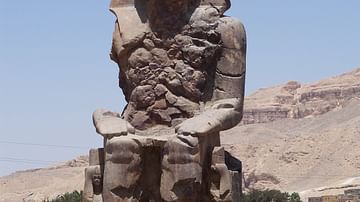
Colossus of Memnon
The south colossal statue of Amenhotep III, one of a pair of such figures known as the Colossi of Memnon. 18th Dynasty, 14th century BCE. Luxor, Egypt.
