
Search
Did you mean: Punt?
Remove Ads
Advertisement
Search Results

Definition
Helios
Helios (also Helius) was the god of the Sun in Greek mythology. Helios rode a golden chariot which brought the Sun across the skies each day from the east (Ethiopia) to the west (Hesperides). Helios was famously the subject of the Colossus...
Definition
Macrinus
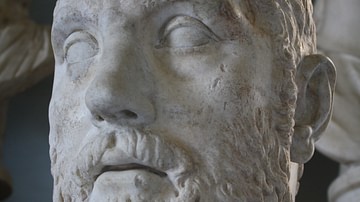
Macrinus was Roman emperor from April 217 to June 218 CE. It is a story that has been told countless times before - an emperor is assassinated leaving no heir or successor. On April 8, 217 CE Roman Emperor Caracalla was murdered, supposedly...

Article
Twelve Great Viking Leaders
The Viking Age (c. 790-1100 CE) transformed every aspect of the cultures the Norse came in contact with. The Vikings usually struck without warning and, in the early years, left with their plunder and slaves to be sold as quickly as they...
Article
The Arch of Titus, Rome
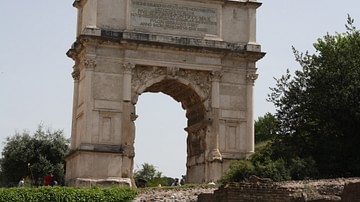
The Arch of Titus is a Roman Triumphal Arch which was erected by Domitian in c. 81 CE at the foot of the Palatine hill on the Via Sacra in the Forum Romanum, Rome. It commemorates the victories of his father Vespasian and brother Titus in...
Article
Temple of Mars Ultor, Rome
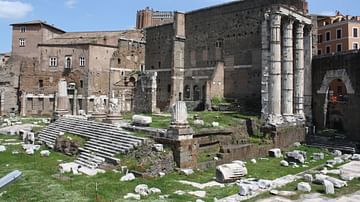
The Temple of Mars Ultor stands in the Forum of Augustus in Rome and was built to commemorate Augustus' victory in 42 BCE at the Battle of Philippi over the assassins of Julius Caesar. The building became the place where important military...

Article
Ara Pacis Augustae
The Ara Pacis Augustae or Altar of the Augustan Peace in Rome was built to celebrate the return of Augustus in 13 BCE from his campaigns in Spain and Gaul. The marble structure, which once stood on the Campus Martius, is a masterpiece of...
Article
Temple of Vesta/Hercules, Rome
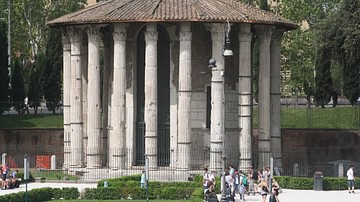
The Temple of Vesta is the popular name given to the round temple near the Tiber River in Rome (now Piazza Bocca della Veritá). The association with Vesta is due to the shape of the building but in fact it is not known to which god the temple...

Video
El Tajín—Veracruz—Mexico
El Tajín is a pre-Columbian archeological site and one of the largest and most important cities of the Classic era of Mesoamerica. A part of the Classic Veracruz culture. The archeological site is known by the local Totonacs, whose ancestors...
Image
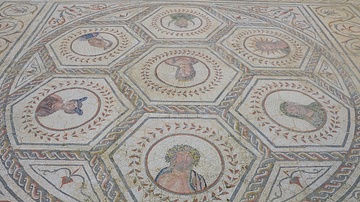
Mosaic with Busts of the Planetary Deities, Italica (Spain)
Mosaic in the House of the Planetarium in Italica (an archaeological site located in modern-day Santiponce, 9 kilometres (5.5 miles) north of Seville in Spain) with busts of the planetary deities who gave their names to the days of the week...
Image
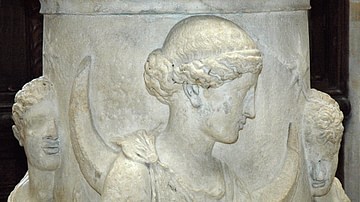
Selene on an Altarpiece
The moon goddess Selene or Luna accompanied by the Dioscuri, or Phosphoros (the Morning Star) and Hesperos (the Evening Star). Marble altar, Roman artwork from Italy, 2nd century CE.
