
Search
Search Results

Article
Causes of the English Civil Wars
The English Civil Wars (1642-1651) were caused by a monumental clash of ideas between King Charles I of England (r. 1625-1649) and his parliament. Arguments over the powers of the monarchy, finances, questions of religious practices and toleration...

Definition
American Revolution
The American Revolution (1765-1789) was a period of political upheaval in the Thirteen Colonies of British North America. Initially a protest over parliamentary taxes, it blossomed into a rebellion and led, ultimately, to the birth of the...

Definition
First Continental Congress
The First Continental Congress was a meeting of delegates from twelve of the Thirteen Colonies of British North America that gathered in Philadelphia, Pennsylvania, from 5 September to 26 October 1774. Its primary purpose was to coordinate...

Definition
Intolerable Acts
The Intolerable Acts, also known as the Coercive Acts, were five laws passed by the Parliament of Great Britain in 1774 to punish the Thirteen Colonies of British North America for the Boston Tea Party. Though the acts primarily targeted...

Article
Battle of Long Island
The Battle of Long Island (27 August 1776), or the Battle of Brooklyn, was an important battle of the American Revolutionary War (1775-1783). It resulted in the defeat of the Continental Army and led to the eventual British occupation of...

Definition
Townshend Acts
The Townshend Acts were a series of acts passed by the Parliament of Great Britain between 1767 and 1768 to tax and regulate the Thirteen Colonies of North America. When the colonists considered the acts an abuse of power and protested them...

Definition
Glorious Revolution
The Glorious Revolution of November 1688 saw Protestant William of Orange (l. 1650-1702) invade England and take the throne of Catholic James II of England (r. 1685-1688). There were no battles, and William was invited by Parliament to become...

Definition
William III of England
William III of England (also William II of Scotland, r. 1689-1702) became king of England, Scotland, and Ireland after the Glorious Revolution of 1688. Protestant William, Prince of Orange, was invited to rule jointly with his wife Mary II...
Image
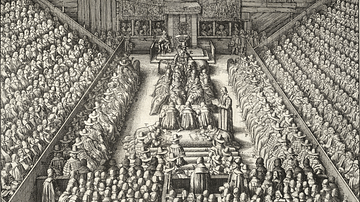
Parliament's Trial of the Earl of Stafford
A 17th-century illustration showing the trial in Parliament of Thomas Wentworth, Earl of Stafford (1593-1641) in May 1641. Stafford was accused of plotting to raise an Irish army to invade England and support King Charles I of England (r...

Image
The Burning of Parliament by Turner
A c. 1834 oil on canvas painting, The Burning of the Houses of Lords and Commons, 16th October, 1834, by J.M.W.Turner (1775-1851). (Philadelphia Museum of Art)
