
Search
Did you mean: Sleipnir?
Remove Ads
Advertisement
Search Results

Article
Battle of Jena-Auerstedt
The twin battles of Jena and Auerstedt, both fought on 14 October 1806, marked a major turning point in the Napoleonic Wars (1803-1815). It saw the French Grande Armée, led by Emperor Napoleon I (r. 1804-1814; 1815) soundly...
Image
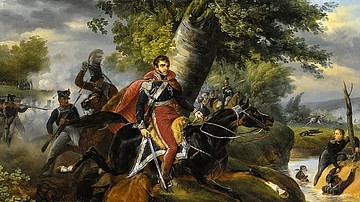
Death of Prince Poniatowski
The death of Prince Józef Poniatowski on 19 October 1813, during the Battle of Leipzig. Oil on canvas by Horace Vernet, 1816.

Image
Olympia Fulvia Morata
Olympia Fulvia Morata, engraving from 1734.
Leipzig University Library.

Image
Cavalry Fight at Möckern
Cavalry fight at the village of Möckern, part of the Battle of Leipzig (16-19 October 1813), illustration from the German-language book Geschichte des Husaren-Regiments von Zieten (Brandenburgisches) Vol. 3 by Armand Freiherr...

Definition
Napoleon Bonaparte
Napoleon Bonaparte (1769-1821) was a Corsican-born French general and politician who reigned as Emperor of the French with the regnal name Napoleon I from 1804 to 1814 and then again briefly in 1815. He established the largest...

Definition
Martin Luther
Martin Luther (l. 1483-1546) was a German priest, monk, and theologian who became the central figure of the religious and cultural movement known as the Protestant Reformation. Even though earlier reformers had expressed Luther's...

Definition
Counter-Reformation
The Counter-Reformation (also known as the Catholic Reformation, 1545 to c. 1700) was the Catholic Church's response to the Protestant Reformation (1517-1648). It is usually dated from the Council of Trent in 1545 to the end...

Definition
German Peasants' War
The German Peasants' War (1524-1525) was a conflict between the lower class of the Germanic region of the Holy Roman Empire and the nobility over the feudal system of serfdom, religious freedom, and economic disparity. It...

Definition
Tycho Brahe
Tycho Brahe (1546-1601) was a Danish nobleman who made the most significant contribution to our knowledge of astronomy before the telescope arrived. He discovered a supernova, observed the elliptical interplanetary orbit of a comet...

Definition
Ludwig van Beethoven
Ludwig van Beethoven (1770-1827) was a German composer of Classical and Romantic music; he is widely regarded as one of the greatest musicians to have ever lived. Most famous for his nine symphonies, piano concertos, piano...
