
Search
Did you mean: Levant?
Remove Ads
Advertisement
Search Results

Definition
Near East - A Modern Term for an Ancient Land
The 'Near East' is a modern-age term for the region formerly known as the 'Middle East,' comprising Armenia, Cyprus, Egypt, Iraq, Iran, Israel, Jordan, Lebanon, Palestine, Syria, and part of Turkey, corresponding...

Definition
Tyre
Tyre (in modern-day Lebanon) is one of the oldest cities in the world, dating back over 4,000 years, during which it has been inhabited almost continuously. It was one of the most important, and at times the dominant, city of Phoenicia...

Definition
Sargonid Dynasty
The Sargonid Dynasty was the last ruling house of the Neo-Assyrian Empire from 722-612 BCE, beginning with the reign of Sargon II and ending with fall of the Neo-Assyrian Empire. Some of the most famous kings in the history of...

Definition
Byblos
Byblos was the ancient Phoenician port city of Gebal (called Byblos by the Greeks) on the coast of the Mediterranean sea in what is, today, Lebanon. According to the historian Durant, “Byblos thought itself the oldest of all cities; the...

Definition
Freya Stark
Freya Stark (l. 1893-1993) was an English explorer, writer, and political influencer who chronicled world events, especially in the Near East, throughout the 20th century. Stark both reported on and made the news as her travels, described...
Image
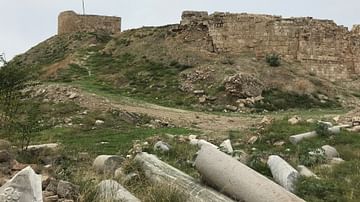
Saint Louis Castle
A photo showing Castle of Saint Louis, a ruined crusader castle located in Sidon, Lebanon. Built by the French crusaders in 1254 CE.

Article
Battle of Marj Ayyun
The Battle of Marj Ayyun (10 June 1179, also given as the Battle on the Litani) was a military engagement between Baldwin IV, King of Jerusalem (r. 1174-1185) and Saladin, Sultan of Egypt and Syria (r. 1174-1193). Saladin...

Article
The Siege of Damascus, 1148 CE
The siege of Damascus in 1148 CE was the final act of the Second Crusade (1147-1149 CE). Lasting a mere four days from 24 to 28 July, the siege by a combined western European army was not successful, and the Crusade...

Article
The AlUla World Archaeology Symposium 2024 - Three Days of Learning and Sharing Amongst Archaeologists
I was recently invited to an archaeological symposium at the site of AlUla in Saudi Arabia. I had known about AlUla since 2018 and seen photographs of the amazing...

Definition
Byzantine Empire
The Byzantine Empire existed from 330 to 1453. It is often called the Eastern Roman Empire or simply Byzantium. The Byzantine capital was founded at Constantinople by Constantine I (r. 306-337). The Byzantine Empire varied in...
