
Search
Did you mean: Levant?
Remove Ads
Advertisement
Search Results

Image
Alexander Sarcophagus (detail)
The Alexander Sarcophagus is a late 4th century BCE stone sarcophagus adorned with bas-relief carvings of Alexander the Great. The Alexander Sarcophagus is one of four massive carved sarcophagi, forming two pairs...

Image
Temple of Baachus, Baalbek
The temple of Baachus at Baalbek (Modern Lebanon), ca. 150 CE.

Image
Tyche On a Golden Double Shekel
Golden double shekel from Tyre in today's Southern Lebanon, dated 104/103 BCE, two decades after the Phoenician city regained its independence from the fading Seleucid Empire, depicting the head of deity Tyche (Fortuna...
Image
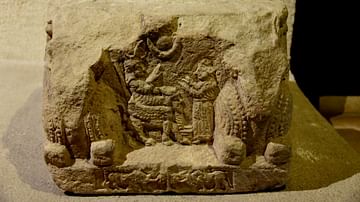
Votive Altar for Astarte
This is a limestone votive altar dedicated to the mother goddess Astarte. End of the 5th century to the beginning of the 4th century BCE. From Lebanon, probably from Fii village. (Museum of Archaeology, Istanbul, Turkey...

Image
Alexander Sarcophagus
This is a side panel of the Alexander Sarcophagus, a stone sarcophagus adorned with bas-relief carvings of Alexander the Great from the 4th century BCE. Discovered in Sidon, Lebanon and residing in the Istanbul Archaeology...
Image
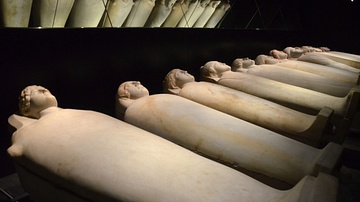
Anthropoid Sarcophagi from Sidon
Phoenician anthropoid sarcophagi from Sidon (modern-day Lebanon), beautifully carved in white marble from Greece. The sarcophagi consist of a hollowed lower box covered by a lid that slightly conveys the contours...
Image
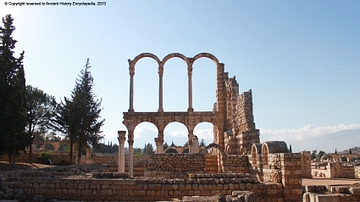
Anjar
The 8th century CE ruins of Anjar, a city of the Umayyad civilization (modern day Lebanon). The palace of the Caliph - highest area of the whole site - the Roman arcade is clearly seen. The site reveals a long period of early occupation...
Image
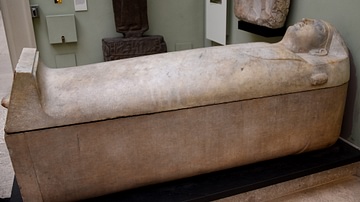
Phoenician Coffin from Sidon
This white marble anthropoid (human-shaped) coffin shows a male head wearing a Egyptian style headdress. Phoenician art was influenced by many different traditions. Coffins of this Gaeco-Egyptian style have been found...
Image
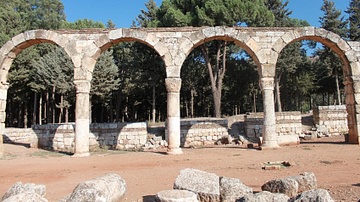
Umayyad Arcades, Anjar
The arcades of Anjar (8th century CE) in modern Lebanon are a typical feature of Umayyad architecture.
Image
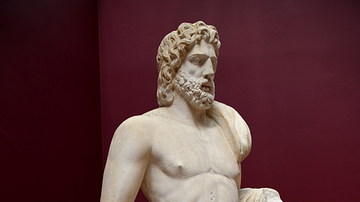
Statue of Poseidon from Byblos
Poseidon was the god of the sea. He is depicted naked, with his mantle thrown over his left shoulder, encircling his left arm; the latter would have held something, probably a tribute, such as a small dolphin. The...
