
Search
Did you mean: Xibalba?
Remove Ads
Advertisement

 This answer was generated by
 Search Results
Image
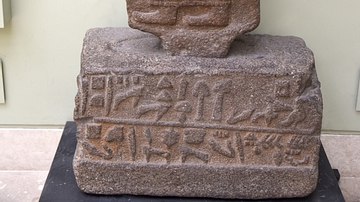
Goddess Kubaba
This image shows two objects: The free-standing basalt stele depicts the goddess Kubaba, consort of the storm god Teshub, and one of the most important deities at the city of Carchemish. Kubaba stands below a winged-disc and...

Image
Hittite Basalt Stela Showing Goddess Kubaba
The upper part is a freestanding basalt monument depicting the goddess Kubaba, consort of the storm god Teshub, and one of the most important deities at Carchemish. She holds a mirror and pomegranate, symbols...

Video
Queen Kubaba of Mesopotamia: the Only Queen on the Sumerian King List
Queen Kubaba of Mesopotamia is known as the only queen who has been named on the Sumerian King List, which is unsurprisingly, a bit of a boy’s club. Kubaba is one of very few women who...

Article
Women in Ancient Mesopotamia - Celebrating the Feminine Principle in the Near East
The lives of women in ancient Mesopotamia cannot be characterized as easily as with other civilizations, owing to the different cultures over time. Generally speaking, though...

Article
Ten Great Ancient Mesopotamian Women - Monarchs, Generals, and Scribes
The lives of women in ancient Mesopotamia were regulated by a patriarchal hierarchy, but within this social structure, there were many who distinguished themselves and some who were able...

Definition
Early Dynastic Period in Mesopotamia - Era of Many of the "Firsts" in Civilization
The Early Dynastic period in Mesopotamia is the modern-day archaeological term for the era in Mesopotamian history – circa 2900 to circa 2350/2334 BCE – during which some of...

Definition
Kish - The First City of Political Prominence in History
Kish was one of the most significant and politically prestigious city-states in ancient Mesopotamia. According to the Sumerian King List, it was the first city to be given divine kingship after...

Definition
Mesopotamian Government - Helping and Serving the Gods
Ancient Mesopotamian government was based on the understanding that human beings were created to help and serve the gods. The high priest, king, assembly of elders, governors, and any other officials...

Article
12 Great Cities of Ancient Mesopotamia - The Rise and Fall of the Earliest Cities in the World
The great cities of Mesopotamia ("the land between two rivers") developed prior to the late 4th millennium BCE along two rivers – the Tigris and Euphrates – and were...

Video
A Short History of Assyria and the Neo-Assyrian Empire
Assyria has a long history, beginning in northern Mesopotamia and then expanding during the Neo-Assyrian Empire from Mesopotamia through Asia Minor, and down through Egypt. The empire began in the...
