
Search
Remove Ads
Advertisement
Search Results

Article
Coronation of Napoleon I
The Coronation of Napoleon I as Emperor of the French took place on Sunday 2 December 1804, in the Notre-Dame de Paris cathedral. A sacred ceremony held to legitimize Napoleon's reign, the coronation signaled the birth...

Definition
St. Bartholomew's Day Massacre
The St. Bartholomew's Day Massacre was a widespread slaughter of French Protestants (Huguenots) by Catholics beginning on 24 August 1572 and lasting over two months, resulting in the deaths of between 5,000 and 25,000...

Image
Portrait of Louis XIV of France
A c. 1700 portrait by Hyacinthe Rigaud of Louis XIV of France (r. 1643-1715). (Louvre Museum, Paris)

Definition
Hundred Days
The Hundred Days refers to the second reign of French Emperor Napoleon I, who unexpectedly returned from exile to reclaim the French throne. It encompasses Napoleon's triumphant return to Paris on 20 March 1815, his climactic defeat...

Definition
Reign of Terror
The Reign of Terror, or simply the Terror (la Terreur), was a climactic period of state-sanctioned violence during the French Revolution (1789-99), which saw the public executions and mass killings of thousands of counter-revolutionary...

Definition
Napoleon's Campaign in Egypt and Syria
The French Expedition to Egypt and Syria (1798-1801), led by Napoleon Bonaparte, aimed to establish a French colony in Egypt and to threaten British possessions in India. Despite initial French victories, the...

Definition
Richard II of England
Richard II of England reigned as king from 1377 to 1399 CE. The son of the late Edward the Black Prince (1330-1376 CE), Richard would succeed his grandfather Edward III of England (r. 1327-1377 CE), but as he was only 10 years...

Article
The Hundred Years' War: Consequences & Effects
The Hundred Years' War was fought intermittently between England and France from 1337 to 1453 CE and the conflict had many consequences, both immediate and long-lasting. Besides the obvious death and destruction...
Article
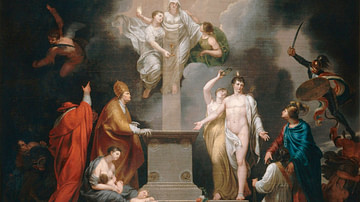
Napoleonic Concordat of 1801 & Religious Pluralism
The Napoleonic Concordat of 1801 defined France's relationship with the Catholic Church for over 100 years. The Organic Articles were added in 1802 and provided state recognition of the Reformed and...

Definition
Mary of Guise
Mary of Guise (aka Marie de Lorraine, 1515-1560) was a French noblewoman who became the second wife of James V of Scotland (r. 1513-1542). With the premature death of her husband, her daughter Mary, Queen of Scots (r. 1542-1567...
