
Search
Remove Ads
Advertisement
Search Results

Article
Ghosts in Ancient Japan
Ghosts (obake or yurei) appear in ancient Japanese folklore and literature, usually in moral tales designed to both warn and entertain but they were also an important element of ancestor worship. If the deceased members...

Image
Enoshima Hetsunomiya Shrine
The Hetsunomiya Shrine is one of several ancient shrines located on the island of Enoshima, which is just offshore from Kamakura, Japan. It was founded by Minamoto no Sanetomo in 1206 CE. Here, visitors pay their respect...

Image
Japan's Kamikaze Warfare (1944–1945) - Japan's Organized Special Attack Campaign in WW II
Kamikaze or Tokkō (short for Tokubetsu Kōgekitai, "Special Attack Units") was Japan's organized campaign of deliberate suicide attacks during the final phase of the Second...

Definition
Jomon Period
The Jomon Period is the earliest historical era of Japanese history which began around 14500 BCE, coinciding with the Neolithic Period in Europe and Asia, and ended around 300 BCE when the Yayoi Period began. The name Jomon, meaning...
Definition
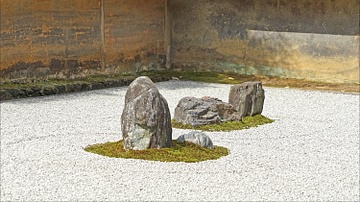
Ryoanji
Ryoanji (Ryōan-ji) is a Zen Buddhist temple in Kyoto, Japan which is today most famous for its Zen rock garden with its enigmatic arrangement of stones. Founded in the 15th century CE, the temple is one of the most visited tourist spots...

Definition
Sengoku Period
The Sengoku Period (Sengoku Jidai, 1467-1568 CE), also known as the Warring States Period, was a turbulent and violent period of Japanese history when rival warlords or daimyo fought bitterly for control of Japan. The period falls...
Definition
Hyangga
Hyangga was a form poetical 'country song,' distinct from contemporary Chinese songs, which were written in the Silla and Goryeo kingdoms of ancient Korea between the 7th and 10th century CE. The indigenous songs cover such topics as...

Definition
Shinto Architecture
The architecture of the 80,000 Shinto shrines in Japan varies depending on geographical location, the deity worshipped, and the date of foundation. The earlier Shinto shrines tend to be simpler and less decorative affairs than...

Definition
Asuka Period
The Asuka Period (Asuka Jidai) of ancient Japan covers the period from 538 CE to 710 CE and, following on from the Kofun Period (c. 250-538 CE), so constitutes the latter part of the Yamato Period (c. 250-710 CE). For some scholars...

Definition
To-ji
The To-ji Shingon Buddhist temple complex is located in Kyoto, Japan. Founded in 796 CE, its five-storey wooden pagoda is the largest in Japan, a symbol of the city, and listed as a National Treasure. The complex includes other examples...
