
Search
Remove Ads
Advertisement
Search Results

Definition
Claude Monet
Claude Monet (1840-1926) was a French impressionist painter who transformed modern art with his emphasis on light brushstrokes, bright colours, and uncluttered nature. Famed for his landscapes and series of paintings that captured...
Definition
Kiyomizu-dera
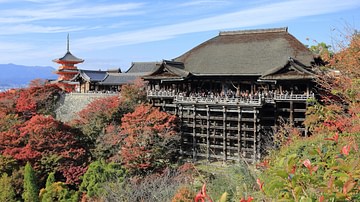
Kiyomizu-dera, otherwise known as the 'Temple of the Pure Water Spring', is a Buddhist temple in Kyoto, Japan. The site is famous for its impressive viewing platform, three-storey Koyasu pagoda and the medicinal pure waters of the...

Definition
Bloody Sunday in 1905 - The Massacre at the Tsar's Winter Palace
Bloody Sunday on 22 January 1905 was the massacre of peaceful and unarmed protestors by soldiers outside the Winter Palace in St. Petersburg, Russia. The crowd of workers and their families...

Definition
Minamoto Clan
The Minamoto clan was an extended family group which dominated Japanese government and the imperial court in the 12th and 13th centuries CE. The clan famously defeated their arch rivals the Taira in the Genpei War of 1180-1185 CE...

Definition
Korean Pottery
The pottery of ancient Korea stretches back to prehistory when simple brown wares were made and decorated with geometrical incisions. Potters would benefit from the ideas and techniques of their Chinese counterparts and go on to...
Definition
Haniwa
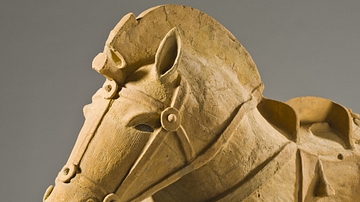
Haniwa are the unglazed terracotta rings, cylinders, and figures of people, animals, and houses which were deposited at Japanese tombs during the Kofun and Asuka Periods (c. 250-710 CE). The exact purpose of these offerings is not known...

Definition
League of Nations
The League of Nations was founded in January 1920 to promote world peace and welfare. Created by the Treaty of Versailles, which formally ended the First World War (1914-18), the League provided a forum where nations promised...

Definition
Balhae
The Balhae (Parhae) kingdom in Manchuria (698-926 CE) was an important regional power which interacted both peacefully and otherwise with its neighbours the Unified Silla Kingdom of Korea and Tang China. The latter was a strong cultural...

Definition
B-17 Flying Fortress
The Boeing B-17 Flying Fortress was a four-engined heavy bomber plane used by the air forces of the United States and Britain during the Second World War (1939-45). The B-17 had unusually heavy defensive armament, 13 machine...

Definition
Juno
Juno was the Roman goddess who protected the nation as a whole but also kept special watch over all aspects of women's lives. She is often thought of as the Roman version of the Greek goddess of love and marriage, Hera. Juno was the wife...
