
Search
Remove Ads
Advertisement
Search Results

Definition
Charles I of England
Charles I of England (r. 1625-1649) was a Stuart king who, like his father James I of England (r. 1603-1625), viewed himself as a monarch with absolute power and a divine right to rule. His lack of compromise with Parliament...

Definition
Spanish Galleon
The Spanish galleon (Spanish: galeón, nao, or navío) was a particularly large type of galleon used for both carrying cargo and as a warship armed with up to 60 cannons. Used from the mid-16th century until the early 19th century...

Definition
Eighty Years' War
The Eighty Years' War (1568-1648, also known as The Dutch Revolt and Dutch War of Independence) was a military conflict between the seventeen provinces of the Netherlands and Spain, which then governed them, beginning in the...

Definition
Silphium
Silphium (also known as laser) was an uncultivated plant that grew in Cyrene, North Africa (modern Shahhat, Libya) and became the cash crop of the region of Cyrenaica between c. 631 BCE and the 1st century CE when, according to Pliny...

Definition
Pawnee
The Pawnee are a Native American nation of the Plains Indians culture originally from the region of modern Nebraska. Prior to the European colonization of the Americas, they were among the most powerful of the Plains Indian tribes numbering...

Definition
Persepolis
Persepolis was the capital of the Persian Achaemenid Empire from the reign of Darius I (the Great, r. 522-486 BCE) until its destruction in 330 BCE. Its name comes from the Greek Perses-polis (Persian City), but the Persians knew...

Definition
Theseus
Theseus is a legendary hero from Greek mythology who was considered an early king of Athens. Famously killing villains, Amazons, and centaurs, Theseus' most celebrated adventure was his slaying of the fearsome Minotaur in the labyrinth...

Definition
Pompeii
Pompeii was a large Roman town in Campania, Italy which was buried in volcanic ash following the eruption of Mt. Vesuvius in 79 CE. Excavated in the 19th-20th century, its excellent state of preservation gives an invaluable insight into...

Definition
Claudius - The Unlikely Roman Emperor
Claudius (10 BCE to 54 CE) was the fourth Roman emperor, who reigned from 41 to 54 CE. Though a member of the imperial Julio-Claudian Dynasty, his rise to power had always seemed unlikely. Indeed, for much of his...
Definition
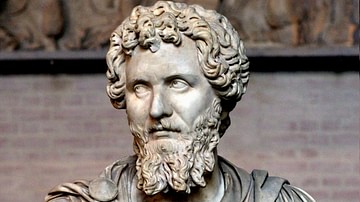
Septimius Severus
Lucius Septimius Severus was Roman emperor from April 193 to February 211 CE. He was of Libyan descent from Lepcis Magna and came from a locally prominent Punic family who had a history of rising to senatorial as well as consular...
