
Search
Did you mean: Stone Age?
Remove Ads
Advertisement
Search Results

Article
The History of Excavations at Tel Gezer
The archaeological site of Tel Gezer is located in central Israel at the edge of the western mountains near the Shephelah, about 9 or 10 km southwest of the city of Ramleh. Gezer was one of the famed "Solomonic"...

Image
Iron Duke Locomotive
A working replica of the Iron Duke locomotive class of steam trains. designed for use on the Great Western Railway lines from the mid-19th century. (Great Western Society's Didcot Railway Centre)

Image
Iron Thorax Armour from Epirus
Iron anatomical thorax with golden buckles found in Cist grave 1 in Prodromi, Thesprotia, Epirus, Greece. The grave is dated to between the end of the 4th century BCE and the beginning of the 3rd century BCE. (Archaeological...

Image
Iron Pillar of Delhi
The Iron Pillar in Qutub Complex, Delhi is a stellar example of advanced metallurgy technology in Gupta Period (circa 320 - 550 CE). The 7 m (23 ft) high pillar was made corrosion resistant. It bears Sanskrit - Brahmi inscriptions...

Image
Iron Peritrachelion (gorget) from Macedonian Tomb II of Vergina
Iron peritrachelion (gorget) with golden-silver decorative plate found in Macedonian Tomb II of Vergina, Imathia, Central Macedonia, Greece. The tomb is dated to between the end of the 4th...

Image
Gaya Iron Helmet
An iron helmet from the Gaya confederacy (42-532 CE), Korea. 5th-6th century CE. (National Museum of Korea, Seoul, South Korea)

Image
Iron Core of Linothorax with Golden Buckles
Iron core of linothorax with golden buckles found in Macedonian Tomb II of Vergina, Imathia, Central Macedonia, Greece. The tomb is dated to between the end of the 4th century BCE and the beginning of the...
Image
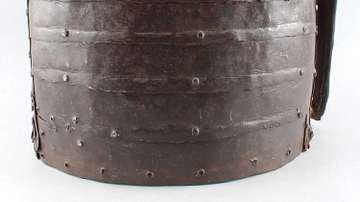
Iron Corslet from Borno
An iron corslet from Borno in what is now Fika, Nigeria. The corslet was acquired by the British Museum in 1911, and is currently a part of the museum's collection.
Image
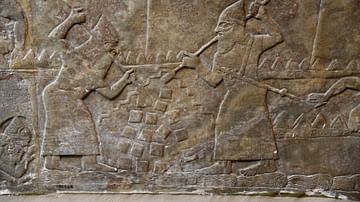
Assyrian Soldiers with Iron Crowbars
Alabaster bas-relief depicting Assyrian soldiers using iron crowbars. Neo-Assyrian Period, 865-860 BCE. Detail of Panel 4 (bottom), Room B, the North-Palace Palace, Nimrud, modern-day Iraq. (The British Museum...

Image
Merovingian Iron Belt Buckle and Fitting
During the 600s CE, supplies of oriental garnets failed and gold and silver grew scarcer. As a result, Frankish jewelers turned to a decorative technique of inlaying designs and silver wire. These often imitated...
