
Search
Remove Ads
Advertisement
Search Results

Definition
Jallianwala Bagh Massacre - The British Atrocity at Amritsar
The 13 April 1919 Jallianwala Bagh Massacre (aka Amritsar Massacre) was an infamous episode of brutality which saw General Dyer order his troops to open fire on an unarmed crowd of men, women...

Article
The Armies of the East India Company
The East India Company (EIC) was first England's and then Britain's tool of colonial expansion in India and beyond. Revenue from trade and land taxes from territories it controlled allowed the EIC to build up its...

Image
Ancient Roman Society and Social Order
This infographic illustrates the complexity and layered dynamics of Ancient Roman society. Structured by wealth, citizenship, ancestry, political privilege, and freedom, Roman social order was rigid yet fluid...

Image
The Feudal Society in Medieval Europe - Power in Medieval Europe: Lords, Land & the Church
The social structure of medieval Western Europe (c. 10th–13th centuries) is often described through the framework of feudal relationships and landholding systems that...

Image
Ancient Indian Ship
This relief depicts an ancient Indian ship likely to have been used by Indian adventurers sailing to Java, Indonesia.
Location: Borobudur temple, Magelang, Central Java, Indonesia

Image
Slave Market of America, 1836: Poster from the Anti-Slavery Society
Broadside condemning the sale and keeping of slaves in the District of Columbia, issued during the 1835-36 petition campaign by the American Anti-Slavery Society, 1836. Library of Congress...

Image
Royal Society Copley Medal
An example of a Copley Medal, the oldest medal awarded by the Royal Society for making an outstanding contribution to the field of scientific knowledge, first issued in 1731.

Image
Map of the Trade in the Indian Ocean 15th-16th century - From Afro-Asian Exchange to European Intervention
The Indian Ocean trade network of the 15th and 16th centuries formed one of the most extensive and dynamic systems of exchange in the premodern world, linking...
Image
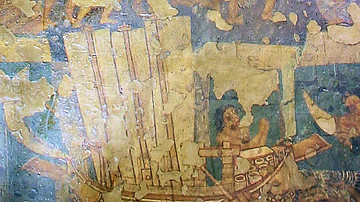
Ancient Indian Ship
This Ajanta mural depicts an ancient Indian ship with high stem and stern and three oblong sails attached to three masts. Steering-oars can also be seen. Location: Cave No. 2, Ajanta Caves, Aurangabad District, Maharashtra...

Article
Trail of Tears: Memorial and Protest of the Cherokee Nation by John Ross
The Trail of Tears was the forced relocation of the "Five Civilized Tribes" – Cherokee, Chickasaw, Choctaw, Muscogee Creek, and Seminole – from their ancestral lands in the Southeastern...
