
Search
Remove Ads
Advertisement
Search Results

Definition
Marcello Malpighi
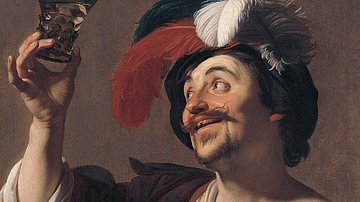
Marcello Malpighi (1628-1694) was an Italian scientist and physician famous for discovering the capillaries of the human circulatory system in 1661 and, as the greatest anatomist of the Scientific Revolution, founding the science...
Definition
Utilitarianism
Utilitarianism is a philosophy founded by Jeremy Bentham (1748-1832) and then extended by other thinkers, notably John Stuart Mill (1806-1873). Utilitarianism involves the greatest happiness principle, which holds that a law or...

Definition
Ancient India
India is a country in South Asia whose name comes from the Indus River. The name 'Bharata' is used as a designation for the country in their constitution referencing the ancient mythological emperor, Bharata, whose story is told...

Definition
Benjamin Franklin
Benjamin Franklin (1706-1790) was an American printer, writer, scientist, inventor, and diplomat, often regarded as a Founding Father of the United States. He rose to prominence as editor of The Pennsylvania Gazette and author...

Article
Causes of the American Revolution
The American Revolution (c. 1765-1789) was a definitive event in Western history that saw the emergence of the United States and helped spawn additional waves of revolutions and societal upheavals on both sides of...

Interview
Interview: Buddhism in Korea
In this interview, James Blake Wiener, Co-Founder and Communications Director at Ancient History Encyclopedia (AHE), speaks to Emeritus Professor James H. Grayson, Professor of Korean Studies at the University of Sheffield...

Article
Kingdom of Magadha: Wars and Warfare
In ancient India from the 6th century BCE onwards, the kingdom of Magadha (6th century BCE to 4th century BCE) made a mark for itself. Located in the eastern part of India in what is today the state of Bihar, it...

Definition
Edmund Burke
Edmund Burke (1729-1797) was an Anglo-Irish statesman and political thinker. His most famous work is Reflections on the Revolution in France a critique of the social and political turmoil in that country in the final decade of the...

Article
Elephants in Hellenistic History & Art
Elephants were thought of as fierce and frightful monsters in antiquity, very real though rarely seen until the Hellenistic period. They were deployed on the battlefield to strike terror into the enemy, however...

Article
European Discovery & Conquest of the Spice Islands
Clove, nutmeg, and mace are native to only a handful of tiny islands in the middle of the vast Indonesian archipelago – cloves on five Maluku Islands (the Moluccas) about 1250 km (778 mi) west of New...
