
Search
Remove Ads
Advertisement
Search Results

Definition
Agrippina the Younger
Julia Agrippina or Agrippina the Younger (6 November 15 - 19/23 March 59 CE) was a prominent woman during the early Roman Empire, niece to Tiberius (r. 14-37 CE) and Claudius (41-54 CE), whom she married, sister of Caligula...

Definition
Napoleon Bonaparte
Napoleon Bonaparte (1769-1821) was a Corsican-born French general and politician who reigned as Emperor of the French with the regnal name Napoleon I from 1804 to 1814 and then again briefly in 1815. He established the largest...

Definition
Zakros
Ideally situated in a sheltered gulf surrounded by mountains, Zakros (or Kato Zakros) in south-eastern Crete, was the fourth largest Minoan settlement after Knossos, Phaistos and Malia. The ancient name has been lost and the present one...

Definition
American Civil War - The Birthpangs of the United States
The American Civil War (1861-1865) was the pivotal event in United States history and the largest armed conflict in the Western world following the end of the Napoleonic Wars (1815) and prior to...

Definition
Utica
Utica (also Utique), 33km north of Tunis, was the first Phoenician colony on the North African coast. The strategically important port was an ally to Carthage in the First Punic War, but the city switched sides in the Second and Third...
Definition
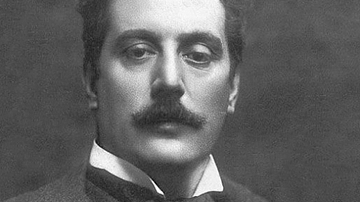
Giacomo Puccini
Giacomo Puccini (1858-1924) was an Italian composer best known for his operas La Bohème, Tosca, Madama Butterfly, and Turandot. Puccini drew inspiration from a wide range of literary sources, and his late Romantic music with its...

Definition
Paros
Paros is an island in the Cyclades group in the central Aegean. It is the third largest island of the Cyclades and its position on important sea routes between mainland Greece and the coast of Asia Minor made it an important centre from...
Definition
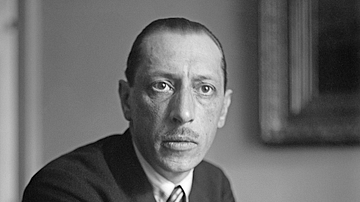
Igor Stravinsky
Igor Stravinsky (1882-1971) was a Russian composer best known for his works for the stage, such as the ballets The Firebird, Petrushka, and the groundbreaking The Rite of Spring. The modernist composer lived in Switzerland, France...

Definition
Vulcan
Vulcan or Volcanus was the Roman god of fire and forge, the equivalent of Hephaestus from Greek mythology. The son of Jupiter and Juno, he was the special patron of blacksmiths and artisans. As the god of the forge and the devastating...

Definition
Cyrenaics
The Cyrenaics were a philosophical school of thought founded c. 4th century BCE by Aristippus of Cyrene (l. c. 435-356 BCE) who taught that sensual pleasure was the highest good and only worthwhile pursuit in life. Known as the first...
