
Search
Remove Ads
Advertisement
Search Results

Video
The Human Body in Ancient Greek Art and Thought
IAN JENKINS, PH.D. SENIOR CURATOR, DEPARTMENT OF GREECE AND ROME, BRITISH MUSEUM Jenkins explores Greek notions of ideal beauty in both nude and draped images of the male and female human bodies. He contrasts...

Image
Vesalius Dissecting a Human Body
The frontispiece of On the Fabric of the Human Body (1543) by Andreas Vesalius (1514-64). The anatomist is shown making a dissection of a human body. (National Library of Medicine)
Image
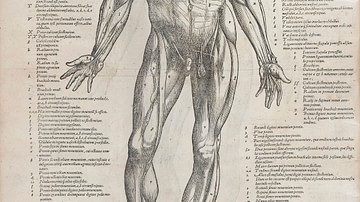
Page from On the Fabric of the Human Body
An intricately labelled diagram of the human muscles from Andreas Vesalius' (1514-1564) celebrated book on anatomy, On the Fabric of the Human Body, first published in 1543. (Wellcome Images)

Article
12 Key Women in Revolutionary Russia
Women were involved in all aspects of the Russian Revolutions of 1905 and 1917 when radical socialists and other sections of society challenged the authoritarian rule of Tsar Nicholas II (reign 1894-1917). As writers...

Image
An Essay on the Inequality of the Human Races
Original edition of Arthur de Gobineau's (1816-1882 CE) An Essay on the Inequality of the Human Races. 1853 CE. Library of the National Museum of Natural History, Paris.

Image
Drawing Showing Mathematical Perspective Applied to the Human Head by Piero della Francesca
A drawing by the Italian Renaissance artist Piero della Francesca (c. 1420-1492 CE) showing his theories of mathematical perspective applied to representing the human...

Image
Nazca Line Human Figure
A Nazca geoglyph depicting a human figure. The designs and lines created on the desert floor of southern Peru are known collectively as the 'Nazca Lines' and were made over several centuries between 200 BCE and 500 CE. Their...

Image
Title Page, Treatise of Human Nature
The title page of Treatise on Human Nature by the Scottish philosopher David Hume (1711-1776). A key text of the Enlightenment, it was first published in 1740. The quote from Tacitus reads: "It is the rare happiness...

Article
Federalist No. 10 - James Madison's Antidote to the Dangers of Factionalism
Federalist No. 10 was an essay written by James Madison, under the pseudonym Publius, and originally published in the New York Daily Advisor on 22 November 1787. It was the tenth...

Definition
Homo Sapiens
Homo sapiens ('wise man'), or modern humans, are the only species of human still around today. Despite having invented countless ways of labelling the world around us, we have so far done a surprisingly poor job at defining ourselves...
